
RituStudio · Phoenix, Arizona · Working Paper
A Taxonomy
of Abstraction
Six dimensions read the painting. Three read the encounter. A working grammar for the meeting between a person and an abstract work.
Preface: At 2am in the Studio
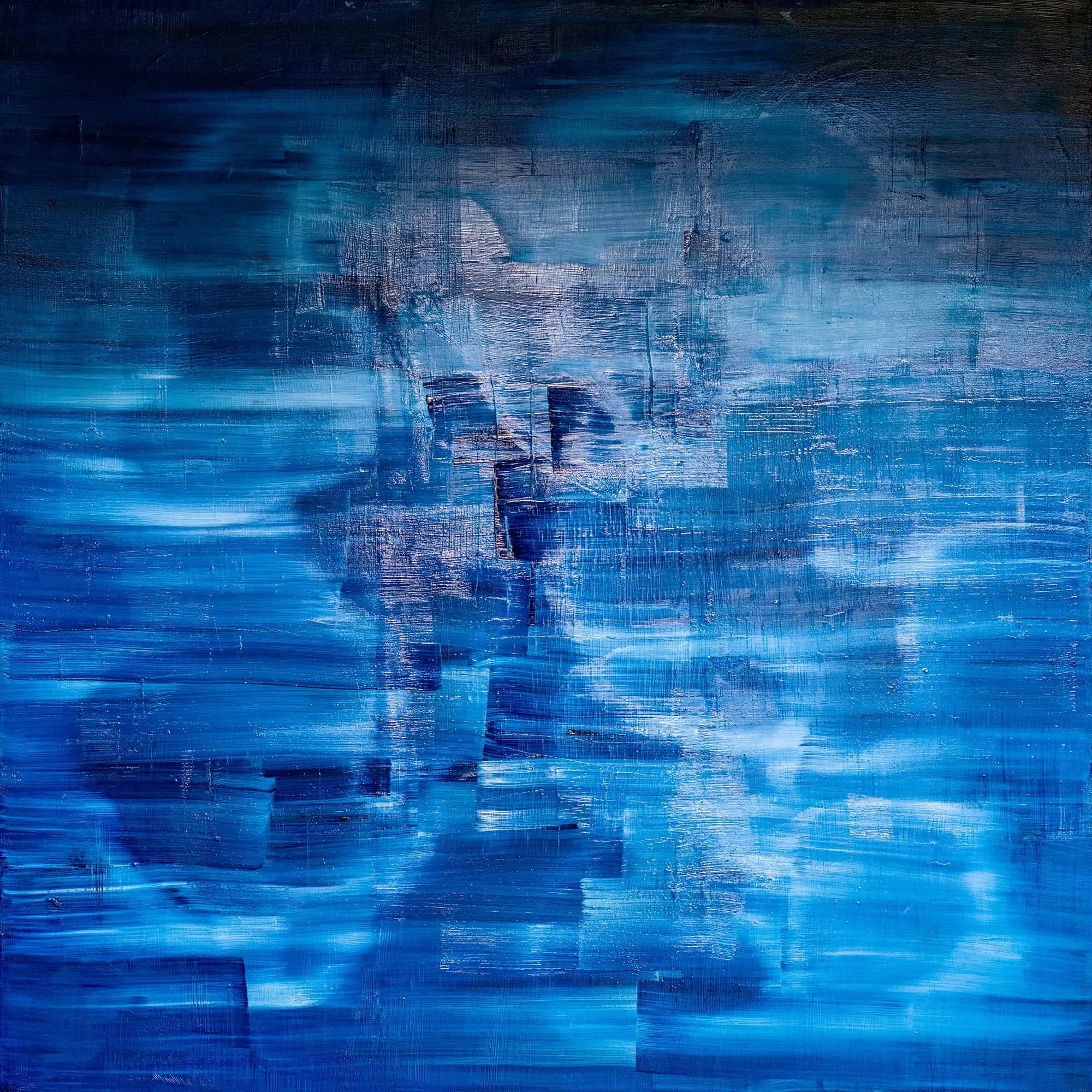
This paper did not begin as a paper. It began as a problem I was trying to solve at two in the morning.
The problem was this: I had made 252 paintings, and I had no way to help someone find the one that was waiting for them.
Not because the paintings were undocumented. They were cataloged, photographed, titled, described. But the language available for describing abstract painting — the language of emotion, of art historical reference, of representation — is not the language a person uses when they are standing in a room, looking at a wall, trying to articulate what they want to feel when they walk in every morning for the next twenty years.
So I started building something. I started with the question: what does a painting actually do? Not what it means. Not what it references. What does it do — physically, perceptually, environmentally — to the person who lives with it?
In trying to answer that question, I ended up building a taxonomy. And the taxonomy split, cleanly, into two halves. Six dimensions to read the painting — the object, the thing on the wall. Three dimensions to read the encounter — the meeting between that object and a particular person, in a particular room, reaching for a particular feeling. The Taxonomy describes the object. Everything beyond it describes the encounter.
The tools came first. The theory followed. This paper is the account of that language.
I. The Wrong Half
Mark Rothko spent the last decade of his life refusing to be sorted.
Call him a colorist and he would correct you — he had no interest, he said, in the relationships between colors. Call him an abstractionist and he would bristle at that too, because that label also sorted him by what his paintings were rather than what they did. He did not want to be filed under a movement, a palette, a technique. What he wanted — what he said, again and again, to anyone who would listen — was for you to stand in front of the canvas and have something happen to you. He wanted the work sorted by the encounter.
He was right. He was right decades before anyone had the language to agree with him.
But watch what he did with that rightness, because it is the whole problem in miniature. Having rejected every available way of describing his work, Rothko was left with nothing to describe it with. So he stopped describing and started controlling. He hung the paintings low, close to the floor, so they would loom. He demanded dim light. He asked that people stand near — eighteen inches, close enough that the color filled the whole field of sight and the edges of the room fell away. He built a chapel. Every one of these decisions is a man protecting the encounter with his bare hands because he had no word for it. Installation standing in for description. A carefully darkened room doing the work a sentence could not do.
That is where the language runs out. Not with a lesser painter — with the greatest painter of the encounter we have. He could say not color, not form, not meaning. He could say no. And then he reached for the dimmer switch, because no was the entire vocabulary he had been given.
This is the quiet failure at the center of every way we sort abstraction. Each one describes the painting and calls it finished. Consider them.
Sort by color and you have cataloged what sits on the canvas — the reds, the veils, the temperature of the ground. You have said nothing about what happens in front of it. Two people stand before the same red. One steadies. One comes undone. The red is identical; the encounter is not. Color tells you what the painting has, never what it does.
Sort by style — Color Field, Abstract Expressionism, the long lineage of gesture — and you have placed the painting in a family. You have traced where it came from. You have said nothing about where it takes the person standing there. Style is genealogy. It reads the object's ancestry and stays silent on the encounter's future.
Sort by emotion — this one is melancholy, that one ecstatic — and you have done something subtler and worse. You have taken a feeling that lives between the person and the painting and pinned it to the canvas, as though it were a property of the pigment. But the feeling was never in the painting. It was in the meeting. Tag the object with it and you erase the person entirely.
Sort by art history — influence, chronology, the argument each canvas makes with the canvases before it — and you have described a long conversation among paintings. A real conversation, and a beautiful one. But not the conversation that matters here: the one between the painting and the single person standing in the dark in front of it.
Sort by meaning — what does it represent, what is it about — and you have committed the founding error, the one abstraction exists to refuse. You have treated the painting as a container for a message to be decoded. Abstraction's whole gesture is to stop being a container. To ask what it means is to arrive already having missed it.
Five ways of sorting. They look like five different tools. They are the same tool, used five times, failing the same way. Each reaches for the encounter and comes back holding the painting. Each describes, with real care, the wrong half.
And now the dimmer switch makes sense. Rothko was not being difficult, or precious. He had diagnosed the failure with perfect accuracy — you are all describing the object, and the object is not where I live — and he had no other half to hand you. So he built rooms. He controlled the light. He staged the encounter he could not name, the way you might hum a melody you have no words for, trusting the other person to catch the tune. This was not a stubbornness to be corrected. It was the completion of a gesture he could only make by refusing.
What if the tune could be caught in words? What if the encounter — the half Rothko could only guard with darkness — could itself be described? Not reduced. Not solved. Described, with the same care we have always spent on the object.
The Double Abstraction Problem
Abstract painting has always demanded a phenomenology of encounter rather than a semiotics of representation. We have never built one.
The critical language available for abstract work — emotional response, art historical lineage, formal description — remains downstream of what a painting actually does to the body and mind of the person standing in front of it. We describe effects. We have no grammar for causes.
This is the double language problem. And it has two layers.
The surface failure is linguistic: we describe paintings through their effects rather than their causes. We say a painting is calming when we mean it has low chromatic tension and dissolving form. We say it is bold when we mean high formal clarity and saturated color. These descriptions are accurate responses to physical properties. But they are downstream of the thing itself.
Beneath this is a more fundamental problem. Abstract painting has no representational language at all. A painting of a chair can be described by reference to the chair. An abstract painting can only be described by reference to the experience of looking at it. And that experience is irreducibly personal — different for every person, in every space, at every moment.
The Desire Problem
When a person wants an abstract painting, they are not trying to find an object that matches a specification. They are trying to find an object that matches a feeling they cannot yet name.
This is the double abstraction. The painting is abstract. The desire is abstract. There is no representational bridge between them.
Consider what a collector actually says when they begin looking. They say: something calming. Something that isn't too busy. Something with warmth. These are not descriptions of objects. They are descriptions of desired encounters. And they are entirely inadequate for finding the specific painting that will produce the specific encounter they are imagining.
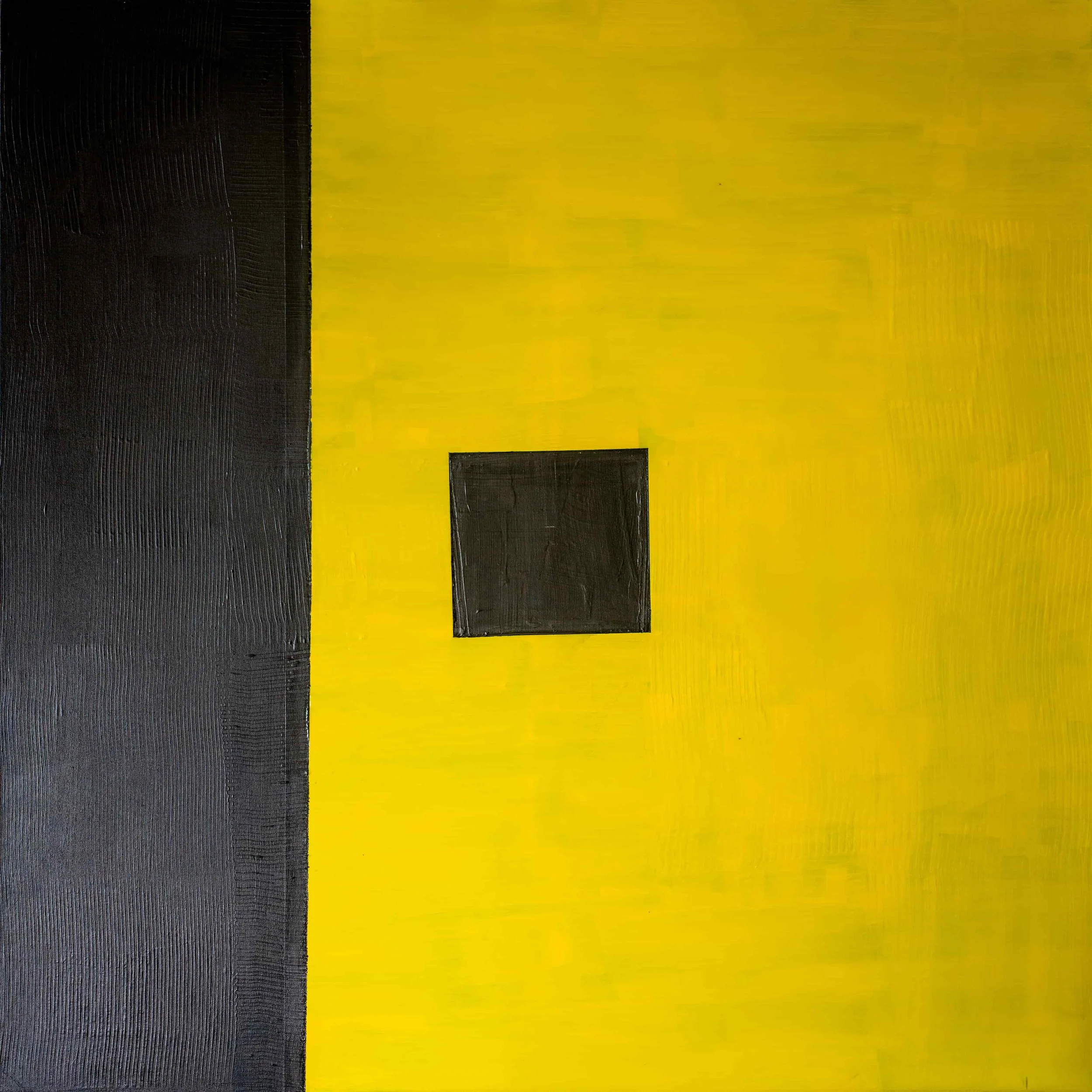
A collector who says "I drive a Ferrari and I want something that understands that" is giving, in one sentence, the complete description of a desired encounter: precision, control, performance, restraint, Italian color, zero sentimentality. Ferrari Aperture — a luminous yellow field with a single black aperture at its center — is the answer to that description. The painting contains no reference to Ferrari. The match happens at the level of encounter, not representation.
So the taxonomy has to do two jobs at once. It has to read the painting precisely enough to know what it is and what it does. And it has to read the person precisely enough to know what they are reaching for. Six dimensions for the first job. Three for the second.
II. The Painting — Six Dimensions
Six dimensions describe the painting itself: what it materially is, how it behaves, and how far it has traveled from representation. Five describe its surface and character. The sixth — the Abstraction Quotient — is the keystone, the measure of how completely the work has left the visible world behind.
Three of the six are scored 1 to 5. The scoring is intentionally subjective — these are perceptual categories, not measurable properties — but the subjectivity is bounded.
| Score | Texture | Form | Color Range |
|---|---|---|---|
| 1 | Flat, smooth. No tactile quality. | Pure atmosphere, dissolving edges, no structure. | Monochrome. Single dominant tone. |
| 2 | Slight surface variation. The hand is present but doesn't insist. | Soft edge presence. Form implied rather than built. | Dominant palette with minor chromatic movement. |
| 3 | Worked surface. Multiple passes visible. Some passages catch light differently. | Clear compositional structure. Edges defined but not architectural. | Balanced palette. Multiple hues in dialogue. |
| 4 | High texture. Topographic relief. Visible at a distance. | Strong formal clarity. The composition holds a defined shape. | Wide color range. Chromatic tension active. |
| 5 | Dimensional. Could be read by touch. Raised passages cast shadows. Different at different times of day. | Fully architectural. The painting is a structure, not just an image. | Full spectrum. Maximum chromatic complexity. |
Texture: What Photography Cannot Convey
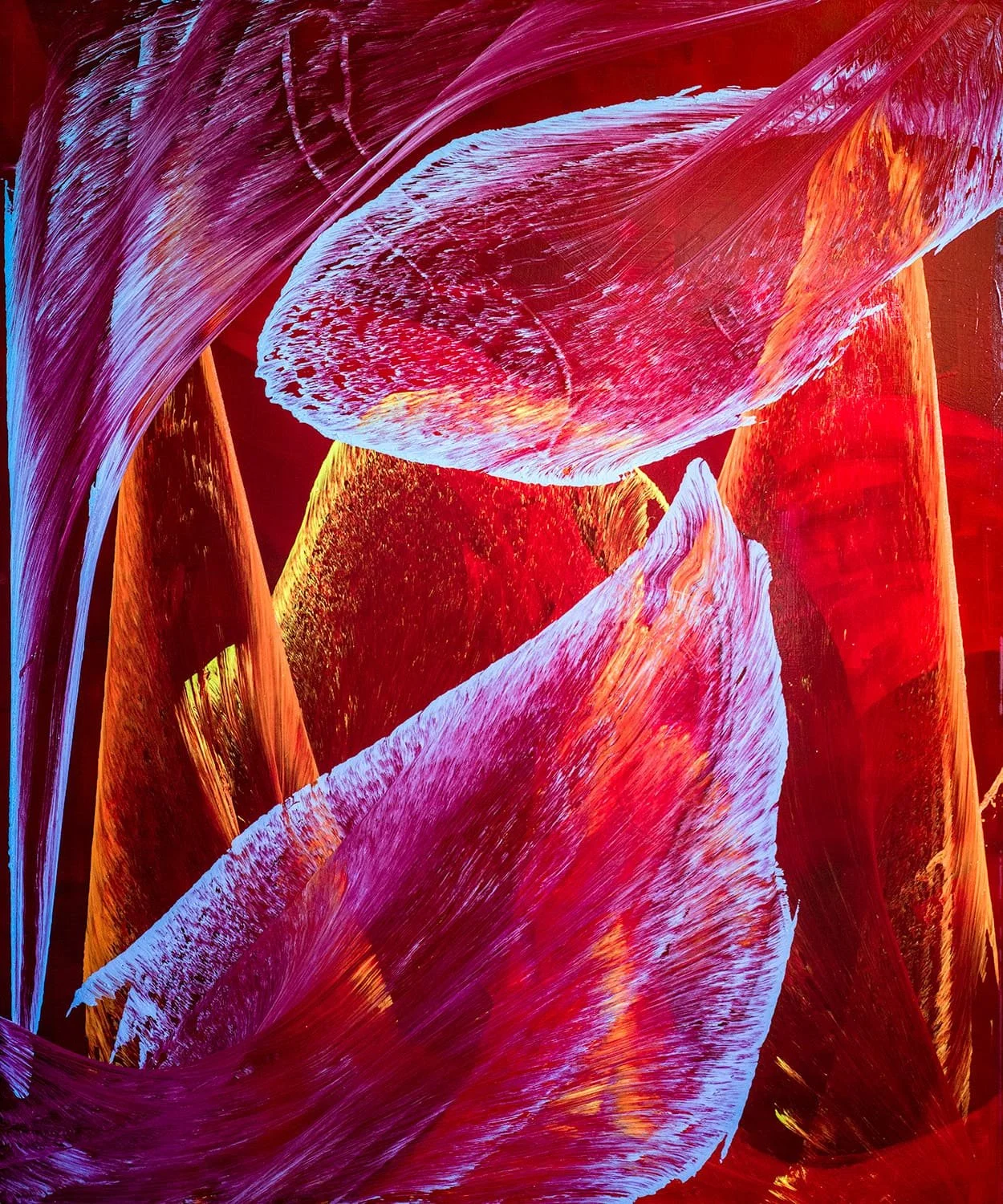
Texture is the one thing photography cannot convey. You can photograph Waves of Threaded Flame — thread pulled through wet paint, fire in full motion — and what you see is beautiful. What you do not see is that the surface has a weave you read by touch as much as by sight. That it changes as you move. That in raking light, in the late afternoon when the sun hits the wall at an angle, the painting becomes something different from what it is at noon.
A high-texture painting in a space with directional lighting is a painting that changes through the day. A low-texture painting in the same space is stable — the same at 7am as at 7pm. Neither is superior. They are different instruments.
Form: The Architecture of the Encounter
Form is structural clarity. The degree to which a painting holds a defined compositional shape. Ferrari Aperture — a luminous yellow field with a single black aperture — is among the simplest paintings in the studio and among the highest in form. The form is absolute. One shape. Perfectly placed.
Most collectors who describe wanting something "not too busy" are in fact describing Form, not color. They want dissolution over structure. Low form. Knowing this changes which paintings are relevant to their space — and changes the conversation entirely.
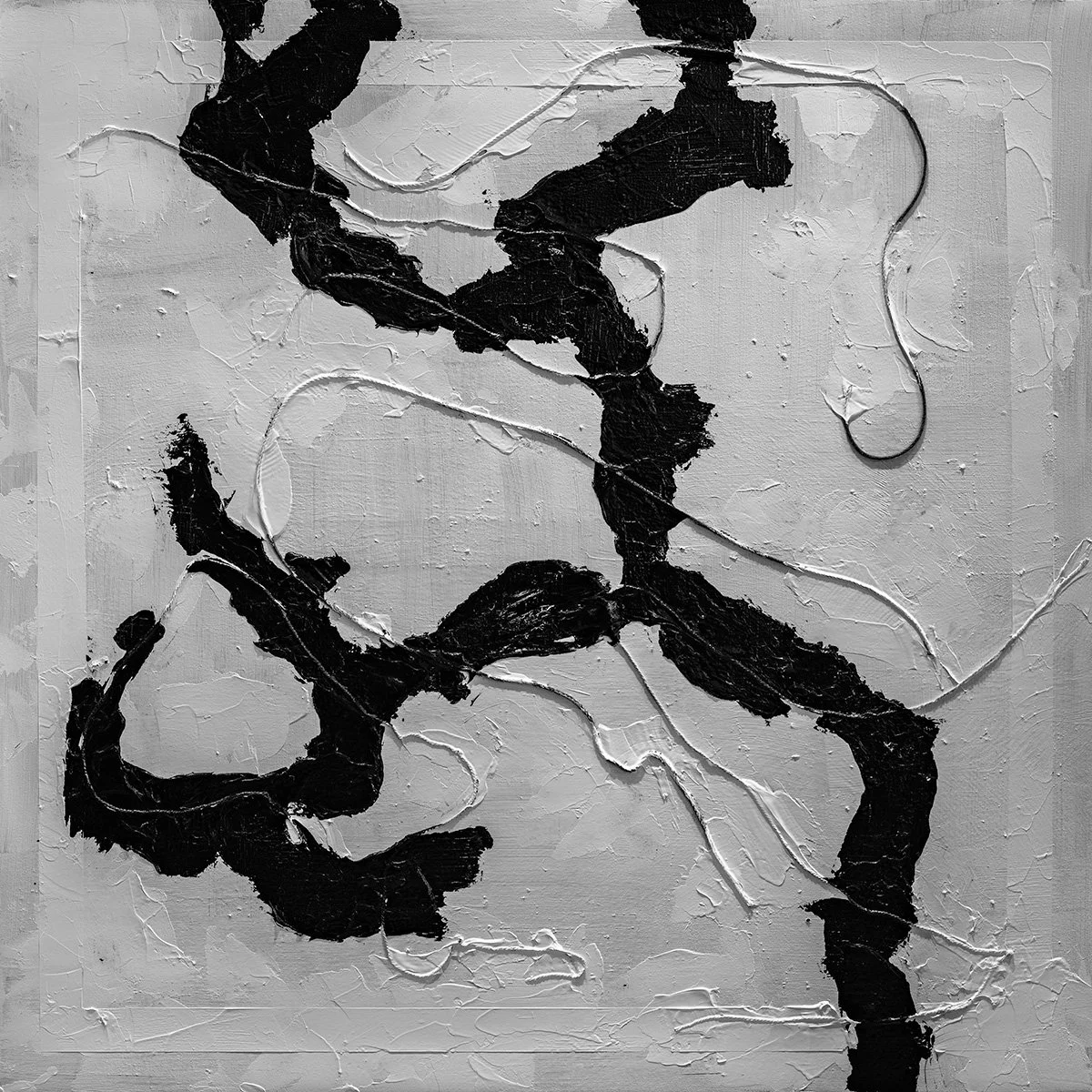
Thread Witness — monochrome, disciplined, two marks choosing different paths — sits at the very top of the texture scale with the color stripped entirely away — maximum surface, no spectrum. The restraint is the message.
Color Range: How Much Work the Painting Does
Color Range is chromatic breadth — the span from monochrome to full spectrum. It is frequently confused with saturation, and the distinction matters. Ferrari Aperture is intensely yellow but has a Color Range of 2 — almost monochrome in its chromatic commitment. Thread Witness is a 1. The discipline is absolute.
A Color Range 5 painting in a room with competing visual complexity will fight everything. A Color Range 1 or 2 painting in the same environment anchors the room by providing a resting point. The eye returns to it, finds nothing that demands resolution, and relaxes. This is not weakness. It is a different kind of strength.
Palette and Mood: The Character of the Surface
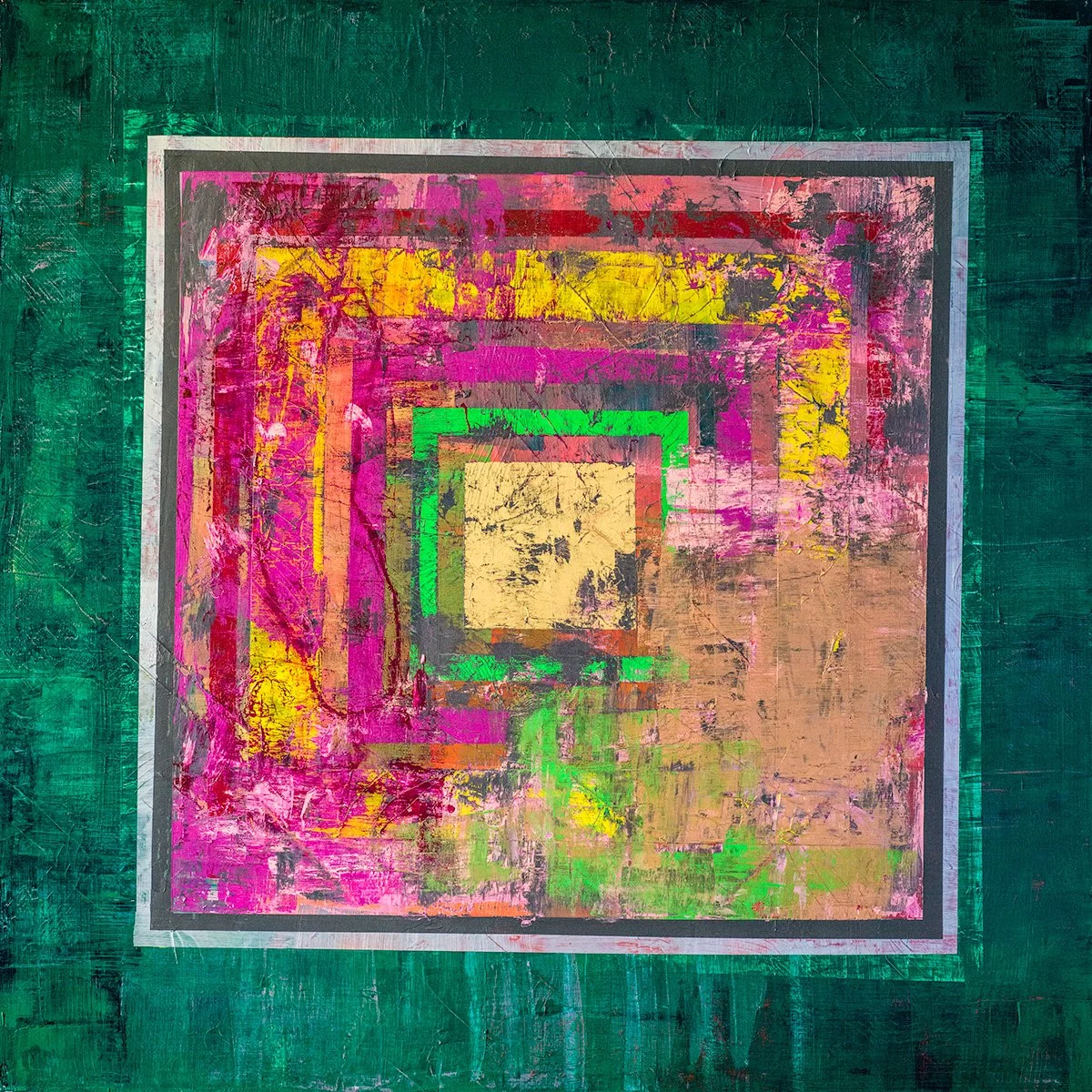
Beyond the three scored dimensions, each painting carries a Palette — its named pigments, temperature, and dominant color — and a Mood, the painting's own emotional register, scored from somber to bright. These are not the collector's mood and not the room's mood. They are the painting's, intrinsic to the object the way texture is.
Rangoli in Permanence — warm terracotta and gold, geometric structure dissolving at the edges into atmospheric warmth — carries a palette that is unmistakably warm and a mood that reads as celebratory, rooted, a geometric joy that refuses to dissolve. A collector who grew up in India, who knows rangoli, who wants something that holds cultural memory without nostalgia — this is their painting. Palette and Mood are how the surface declares its character before a single word of interpretation is spoken.
Abstraction Quotient: The Keystone
The sixth dimension is the one the other five point toward. The Abstraction Quotient measures how far a work has left representation behind — from 0, where a recognizable subject still anchors the eye, to 5, where form has fully departed the visible world and the painting refers to nothing but itself.
It is the keystone because it sets the terms for everything else. A high-AQ painting cannot be met the way a landscape is met; there is no scene to enter, no figure to follow. There is only the surface and what it does to you. Proton Song sits at AQ 5 — maximum abstraction, the furthest edge of non-objective language, where the collision of materials, not the depiction of anything, is the entire subject. Flight of Shadows, for all the abstraction of its means, sits near the other end at AQ 1 — shadows are still shadows, the trace of something passing. The number does not rank the paintings; it tells you what kind of meeting each one asks for. The higher the Abstraction Quotient, the more the encounter becomes the work.
III. The Encounter — Three Dimensions
The six dimensions read the painting. They are not enough. A painting does not happen on a wall; it happens in the meeting between a wall and a person. To read that meeting takes three more dimensions — and these describe not the object but the encounter.
The system that uses this taxonomy is not a search engine. It is a listening system. A search engine takes a query and finds objects that match it. A listening system takes a description of a person and a context, translates it through a structured framework, and finds the encounter that is waiting. The difference is not technical. It is philosophical. And it listens along three axes.

Space: The Context You Have
The first dimension is the room as brief. Where will the work live — the wall, the light, the ceiling height, the architecture, the competing visual complexity, the archetype of the space itself? A collector who says "dark walls, high ceilings, serious collector" is describing the conditions for Cosmos Interstellar — a painting that needs height to become a portal, that needs dark surroundings to make its luminosity visible, that rewards the kind of sustained attention a serious collector brings. Space is the most concrete of the three. It maps directly to scale, to Form, to Color Range, to lighting. It is the encounter's physical envelope.
Transformation: The Context You Want to Create
The second dimension is the mood you want the room to acquire — explicitly not the painting's own Mood, but the change you want it to work on the space and on the people who enter it. "I want people who walk in to feel like they've arrived somewhere serious." "I want the room to slow down." "I want to wake up differently." Transformation is the gap between the room as it is and the room as you want it to feel. The painting is the instrument that closes that gap.
Feeling: The Context You Are

The third dimension is the deepest, and it has two ends. Feeling is what you ultimately want — the thing the painting should do to you, in your room, at midnight, for the next twenty years. And it is read from both directions: from what a person reaches toward before they have seen the work, and from what the work actually did once they stood in front of it. The first end is intent. The second is sentiment. Together they are the loop the whole taxonomy is built to close.
The First End — How People Reach Toward a Feeling
Before a person has seen a specific work, they signal what they are reaching for. This pre-encounter signal — the vocabulary of longing that precedes the meeting — arrives in four forms, each with a different signal strength.
Verbal intent is the most explicit and the least precise. "Something calming." "Not too busy." "Something with warmth." Accurate but upstream — descriptions of desired encounter rather than desired object. The taxonomy translates them: "calming" maps to low Color Range and dissolving Form; "not too busy" to high Form clarity and low chromatic tension; "warmth" to Palette temperature.
Identity intent is less explicit but higher signal. "I drive a Ferrari." "I built a company." "I grew up in New Delhi." These sentences carry complete encounter specifications. Identity intent skips the intermediary of preference and speaks directly to being.
Spatial intent is the room as brief — it is Space, arriving in the collector's own words. "High ceilings, dark gray walls, large windows, limited wall width." The collector who describes their space with this precision has already imagined the painting on the wall.
Outcome intent is the highest signal of all. "I want to be moved." "I want something that holds what I'm carrying right now." The collector who speaks in outcomes is not describing what they want to see. They are describing what they want the painting to do. This is purchase intent in its most honest form. When a collector types "I need yellow as the dominant atmospheric field, the ground everything else happens against," the taxonomy reads not the word "yellow" but the full intent — yellow as field, as ground, as atmosphere — and lands, unambiguously, on Flight of Shadows, where electric yellow is not accent but total condition. Conventional systems returned everything that merely contained yellow. The taxonomy found the one painting where yellow is all of those things at once.
The Second End — What the Painting Actually Did

There is a moment — standing in front of a Rothko, or a Hilma af Klint, or a painting you have never seen before — when something happens in the body before the mind can interpret it. A kind of pressure. A sudden change in the quality of attention. A feeling that you are not just looking at something but being addressed by it. This is the Rothko moment, and it is the reason abstract painting exists. It is the only part of the taxonomy that cannot be assigned by the artist, the curator, or the system. It is assigned by the person who stands in front of the work, before analysis, before language has caught up.
So every painting page asks one question: Something happened when you saw this. What was it? The answer is registered on a five-point scale. Not for me — honest, valid, the highest-quality data; the work did not find its person here. Interesting — cognitive before emotional, the attention engaged but the encounter stayed above the surface. Stops me — the most significant point on the scale; the visitor paused, something happened before they knew what it was. Love it — encounter has crossed into relationship. Moves me — the Rothko moment made legible, an event reported rather than a preference.
Over time these responses accumulate into a public emotional fingerprint — built not by the artist or a curator but by everyone who has stood in front of the work. The fingerprint is not a rating; it preserves the full distribution. And each painting carries a confidence score: how firmly that emotional reading has resolved across the responses gathered so far.
The Loop That Closes
Intent and sentiment are not two dimensions. They are the two ends of one — Feeling — and the gap between them, or the absence of a gap, is the measure of a match. Intent is what someone wanted the painting to do, before they saw it. Sentiment is what it did. When a collector arrives with outcome intent — "I want to be moved" — and then registers moves me on the painting the system surfaced, the loop is closed: the taxonomy read the intent correctly, and the painting delivered. When someone clicks not for me on a painting whose profile predicted resonance, that is the most productive data point of all. Both make the grammar sharper.
And the loop is no longer hypothetical. Proton Song — AQ 5, a collision of materials at the furthest edge of abstraction — reads as awe, at a confidence of 3 across 7 responses: a divided, mid-confidence signal, a work that polarizes rather than builds consensus. Rangoli in Permanence reads as reverence and resolves far more firmly — confidence 4 across 8 responses, the devotion landing the same way for nearly everyone who meets it. Cosmos Interstellar reads as awe yet sits at confidence 2 across 5 responses, its reading still forming. Blue Lagoon reads as longing — confidence 3.5 across 6 responses, a cool ache most who stand before it seem to share. The confidence number is the encounter learning to know itself. Every response sharpens it.
The Taxonomy of Abstraction, across all of its dimensions — six for the painting, three for the encounter — is an attempt to build a system that learns, not through training data in the technical sense, but through accumulated encounters, honestly recorded, carefully read. Not to explain abstract art, which would be to betray it, but to build a language good enough to help the right person find the right painting. A grammar not for making, but for meeting.
IV. Toward a Universal Grammar
The taxonomy proposed here is calibrated to 252 paintings in one studio. But there is nothing in it specific to this studio, this artist, or this period. A Rothko can be scored on these dimensions. A Pollock, a Hilma af Klint, a Clyfford Still. The six read any painting; the three read any encounter. The taxonomy is not about a style. It is about the phenomenology of abstract encounter, which is universal.
This is the larger ambition. Not to describe one catalog, but to propose a framework that could be applied across the full history of abstract painting — giving collectors, curators, designers, and anyone who has ever stood in front of an abstract work and felt something they could not name, a grammar for that feeling. The reading you can run on Proton Song today is the proof of concept: six dimensions reading the object, three reading the encounter, the emotional fingerprint accumulating beneath.
The taxonomy is the grammar. The paintings are the vocabulary. The encounter is the sentence that has never been written the same way twice.
Find Your Painting
Abstract art recommendation engine — powered by AI, a Taxonomy of Abstraction, and the accumulated sentiment of every encounter.
Every dimension in this taxonomy was built toward a single purpose: to make the right recommendation. Not the most popular painting. Not the most expensive. Not the one that photographs well. The one that is waiting for you — in your room, in your life, at this particular moment.
The engine reads who you are before it reads what you want. It listens across the three dimensions of the encounter — the Space you have, the Transformation you want, the Feeling you are reaching for — and matches them against the six dimensions of 252 original works. And it learns, with every session, from the accumulated sentiment of everyone who has stood in front of these paintings and said what happened.
No two recommendations are alike. Because no two collectors are alike. Because no two encounters with an abstract painting are alike. This is not a search engine with a better interface. It is the first system ever built that treats the desire for abstract art as seriously as the art itself.
The Framework: Six + Three
Six dimensions read the painting. Three read the encounter.
| # | The Painting | What it measures | How it is recorded |
|---|---|---|---|
| 1 | Texture | Surface presence and dimensionality | Scored 1–5 |
| 2 | Form | Structural language and compositional clarity | Scored 1–5 |
| 3 | Color Range | Spectral breadth and chromatic energy | Scored 1–5 |
| 4 | Palette | Named pigment character and temperature | Descriptive sequence |
| 5 | Mood | The painting's own emotional register | Scored, somber to bright |
| 6 | Abstraction Quotient | How far the work has left representation — the keystone | Scored 0–5 |
| # | The Encounter | What it reads | How it is read |
|---|---|---|---|
| 1 | Space | The context you have — room, light, scale, architecture | Described + scored space suitability |
| 2 | Transformation | The context you want to create — the change worked on the room | Inferred from intent |
| 3 | Feeling | The context you are — intent before, sentiment after | Intent inferred · sentiment on a 5-point scale, with a confidence score |
Questions the Taxonomy Answers
What is the Taxonomy of Abstraction?
The Taxonomy of Abstraction is a framework for describing the meeting between a person and an abstract painting. It uses six dimensions to read the painting — Texture, Form, Color Range, Palette, Mood, and the Abstraction Quotient — and three to read the encounter — Space, Transformation, and Feeling. Most language about abstract art interprets what a work means; the Taxonomy does something different. It describes what a painting does, physically and perceptually, to the person standing in front of it, and what that person is reaching for. It was created by the abstract painter Ritu Raj.
What are the six dimensions that read the painting?
The six dimensions are Texture, Form, Color Range, Palette, Mood, and the Abstraction Quotient. Texture measures surface presence, from flat to dimensional relief you could read by touch. Form measures structural clarity, from dissolving atmosphere to full architecture. Color Range measures chromatic breadth, from monochrome to full spectrum. Palette names the pigment character and temperature. Mood is the painting's own emotional register, from somber to bright. The Abstraction Quotient, the keystone, measures how far the work has left representation behind. Together they describe the object on the wall, independent of any viewer.
What are the three dimensions that read the encounter?
The three dimensions are Space, Transformation, and Feeling. Space is the context you have — the room, light, scale, and architecture where the work will live. Transformation is the context you want to create — the change the painting works on the room and the people who enter it. Feeling is the context you are — what you reach toward before you see the work, and what the work actually did once you stood in front of it. Where the six dimensions describe the painting, these three describe the meeting, which changes from person to person.
What is the Abstraction Quotient?
The Abstraction Quotient is the keystone dimension of the Taxonomy of Abstraction. It measures how far a painting has left representation behind, scored from 0 to 5. At 0, a recognizable subject still anchors the eye. At 5, form has fully departed the visible world and the painting refers to nothing but itself. It is the keystone because it sets the terms for every other dimension: the higher the Abstraction Quotient, the less there is to read in the ordinary sense, and the more the encounter itself becomes the work.
How is the Taxonomy different from other ways of describing abstract art?
Most ways of sorting abstract art — by color, by style, by emotion, by art-historical lineage — describe the painting and stop there. They read the object and mistake that for reading the experience. The Taxonomy of Abstraction separates the two: six dimensions for the painting, and three for the encounter between that painting and a particular person in a particular room. It treats the encounter as describable in its own right, rather than something to be guessed at from the object. The aim is not to explain what an abstract work means, but to build a language for what it does.
Can the Taxonomy be applied to other artists, such as Rothko or Pollock?
Yes. Although the Taxonomy of Abstraction was calibrated on the paintings in one studio, nothing in it is specific to a single artist or period. A Rothko, a Pollock, a Hilma af Klint, or a Clyfford Still can each be scored across the same six dimensions of the painting and met through the same three dimensions of the encounter. The framework describes the phenomenology of abstract encounter, which is universal — not a style, a movement, or a signature. It is intended as a general grammar for standing in front of any abstract work.
What is the Abstraction Engine?
The Abstraction Engine is an AI-powered discovery tool that uses the Taxonomy of Abstraction to match a person with an original abstract painting. Rather than searching by keyword, it listens: it reads who someone is and the space they have, translates that through the three dimensions of the encounter, and finds the work that answers it. It also learns from accumulated sentiment — what visitors report actually happened when they stood in front of each painting. It can be found at rituart.com/find-your-painting.
RITUSTUDIO · LIVING DATASET
252 paintings.
Four dimensions.
Two kinds of seeing.
Every painting in this catalog has been scored across Abstraction Quotient, Texture, Form, and Color Range — then read independently by AI, with no access to the artist's scores. The gaps between the two readings are where the real data lives.
VIEW THE FULL DATASET →RITUSTUDIO · EMOTIONAL QUOTIENTS
252 paintings.
One question.
What does it do to you?
Every painting in this catalog has been read for its felt emotional response — what happens in the body before the mind interprets. Sixteen emotions. Reverence, grief, awe, longing, aliveness and more. One truth per painting.
VIEW THE FEELING MAP →─ on abstraction - EssaysOn Abstraction - Essays
Where Abstraction Finds Words
They say the future is human-in-the-loop — the machine runs, and we stand by to approve. But to be in the loop is to be the most important person in a room you did not design. I am not interested in supervising the machine. I am interested in authoring the space it reads within.