
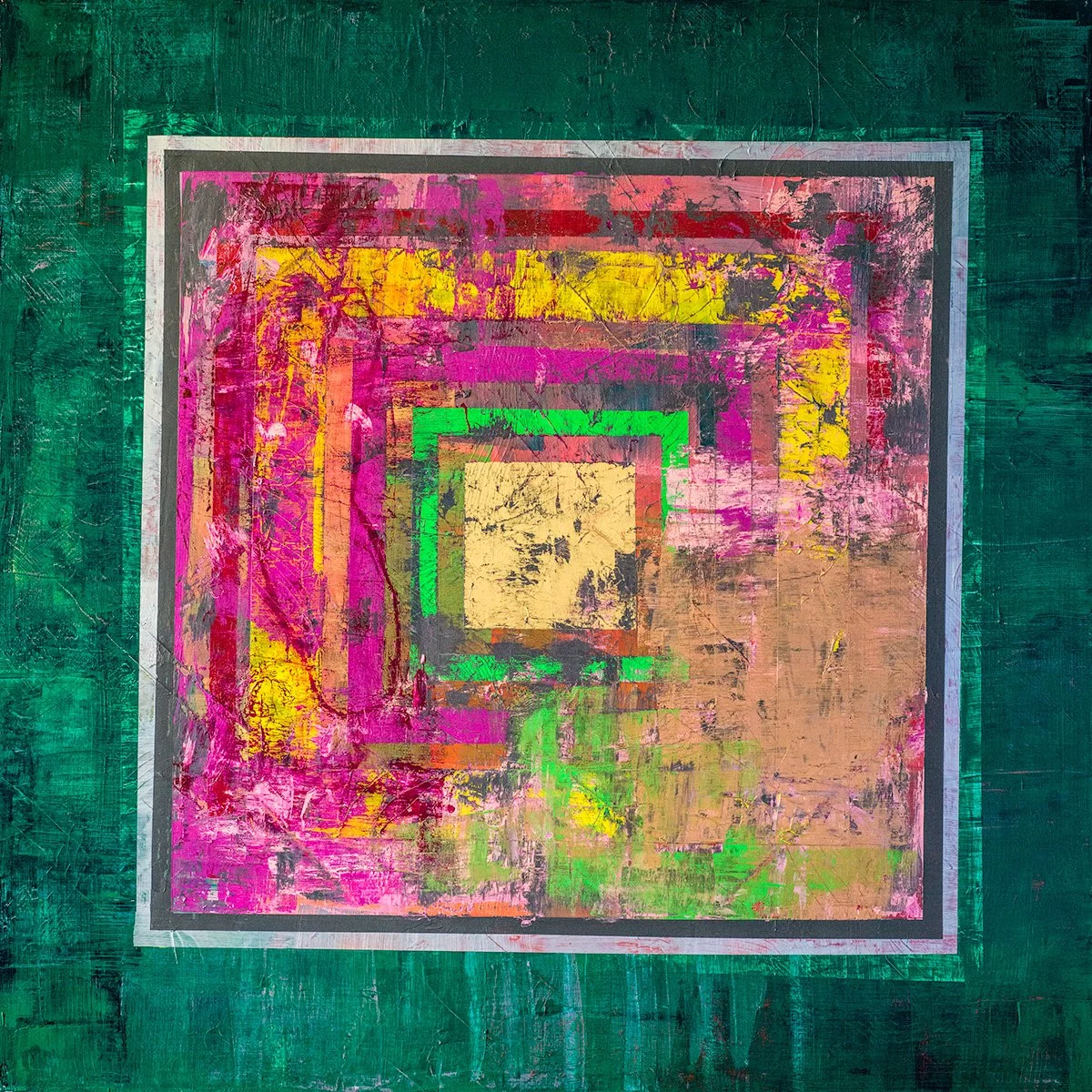
The Painting · Six Dimensions
The Taxonomy describes the objectAbstraction Quotient · keystone · 0–5 · how far the work has left representation
High. The rangoli’s geometry survives, but abstracted into pure pattern and color — you feel the rite without reading the doorstep it was once drawn on. Ephemera, fixed.
Texture · 1–5
Smooth and even — the surface stays quiet so the geometry and color can carry the work. Powder on stone has no impasto, and the painting keeps that.
Form · 1–5
Strong structure — a geometric architecture that dissolves only at its edges into atmospheric warmth.
Color Range · 1–5
Full spectrum — malachite against neon green, magenta against gold, crimson beside near-black, none of it resolved into a scheme. One of nine works in the catalog at 5.
Palette
Contrast · 1–5 · held to wide
Near-black to the brightest green, a wide tonal span carrying a wide chromatic one. Rare: most works reach far in one and not the other.
Theme
Critical Analysis · Abstraction Engine
Rangoli in Permanence takes a form built to be destroyed and refuses the second half of the bargain. The pattern belongs at a doorway, laid in powder, walked across all day and gone by evening. Here it is nested squares in acrylic, held at the center of a five-foot canvas, with a green field pressing in from every side as though the floor had been lifted off the ground and hung on a wall.
At an Abstraction Quotient of 4 the pattern has left the doorstep and become structure. The color range sits at 5, a level only eight works in the catalog reach: malachite against neon green, magenta against warm gold, crimson beside near-black, none of it resolved into a scheme. Texture, at 2, is the surprising number. The surface stays almost flat, because powder on stone has no impasto, and the painting keeps that one fact after abandoning everything else about the original.
What it argues is that an inherited form can be carried without being preserved. The geometry is neither quoted nor modernized. It is simply used, at scale, in the wrong material, by someone with the standing to use it, a harder position to hold than either homage or rupture, and one the painting takes without explaining itself.
⊘ Confidence score of 3.91, across 11 logged responses — a firm, largely shared read: the reverence lands the same way for nearly everyone who meets it.
Six dimensions read the painting. Three read the encounter. The Taxonomy describes the object; ArtGraph is everything beyond it.
The Encounter · Feeling · Emotional Quotient
Confidence Score · from sentiment
How firmly the engine trusts this emotional read. A strong, consistent signal — most who stand here arrive at the same feeling.
Emotional fingerprint — ancient · pattern · holding · time · still
Space
Where it lives — living rooms and hotel lobbies, the cultural interior; a work that wants a wall of its own.
Transformation
What it does to a room — it anchors, the way a great rug anchors a floor; everything present orients toward it.
Feeling
Where it leaves you — reverence: the sense that devotion, poured into geometry, outlasted the moment it was made for.
The Encounter · Space · Best Fit · 0–5
The Encounter · Transformation
Rangoli in Permanence anchors a room the way a great rug anchors a floor — everything orients toward it. In a lobby it announces arrival; guests slow down rather than walk past.
For luxury residential, hospitality, and the cultural institution — for those who want heritage held without nostalgia.
The Work's Own Voice
“A rangoli is made to be erased. You draw it at the threshold at dawn and by evening it’s gone — that’s the whole devotion, the giving of something you know won’t last. I wanted to keep one. Not to stop it being sacred, but to ask what happens when the ephemeral is made to stay. The geometry remembers the doorstep even when the doorstep is gone.”— Ritu Raj, www.rituart.com/paintings/rangoli-in-permanence