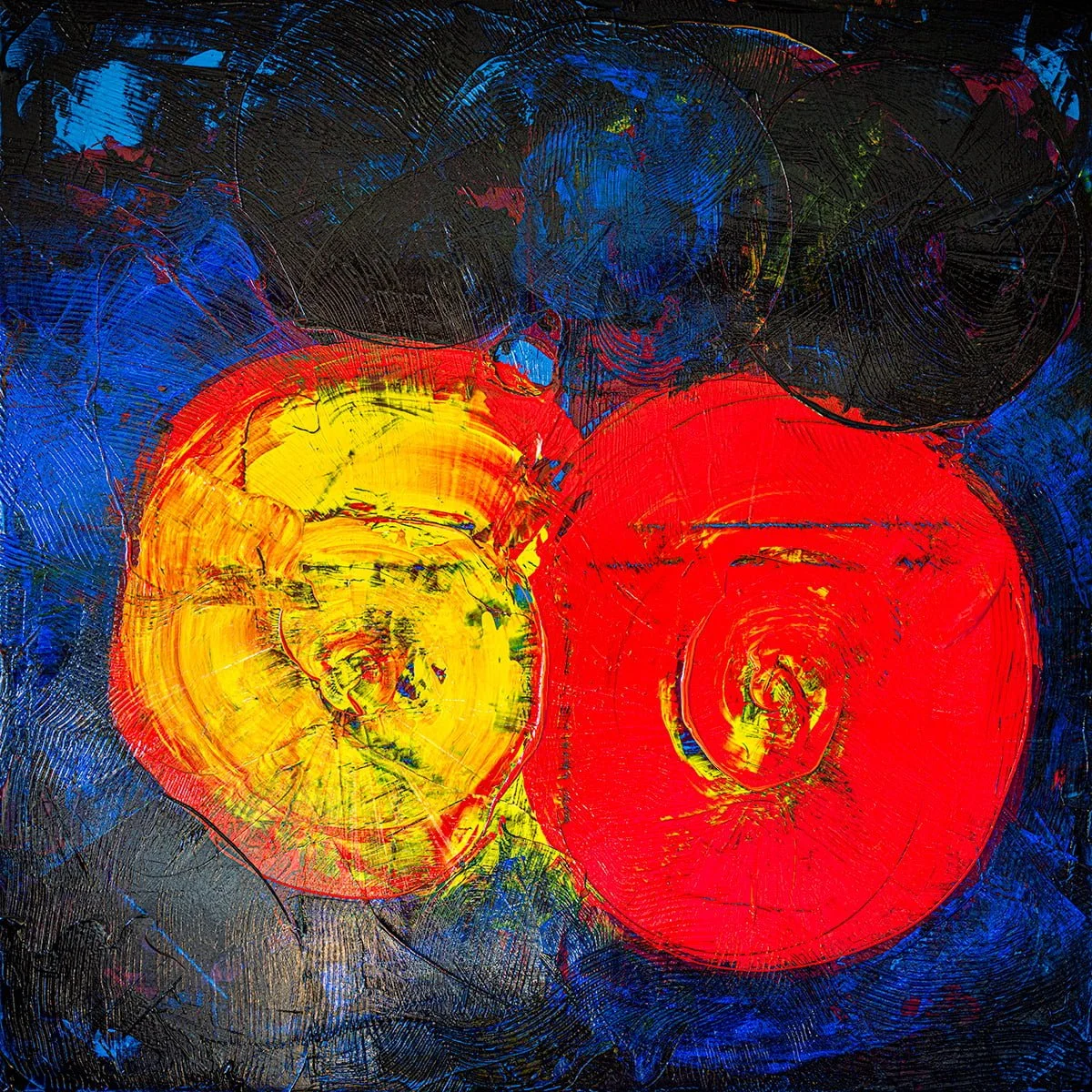
The Painting · Six Dimensions
The Taxonomy describes the objectAbstraction Quotient · keystone · 0–5 · how far the work has left representation
Maximum. The furthest edge of non-objective language in the studio — nothing here refers outward. What the painting is about is the collision of materials itself, and there is no second reading available.
Texture · 1–5
Built and worked — oil laid thickly enough that the luminous passages sit forward of the ground.
Form · 1–5
Four forms holding their positions without hardening into geometry — structure present, edges still negotiable.
Color Range · 1–5
Cadmium red, Prussian blue, mustard and cobalt against graphite black — genuine reach across the wheel, not a single key pushed hard.
Palette
Contrast · 1–5 · held to wide
Mid span. Graphite black to mustard is a real distance, but nothing here goes to white, so the collision stays inside the dark.
Theme
Critical Analysis · Abstraction Engine
Proton Song engages materiality as philosophical inquiry, where the collision of acrylic and oil generates fractal ruptures that dissolve the figure-ground hierarchy, a kinetic abstraction that turns the canvas surface into an active participant. The restraint of the composition belies its ambition: four bodies, two languages of presence, one field of energy.
The Abstraction Quotient of 5 signals maximum formal abstraction, yet the thematic framework around embodied presence and bodies in dialogue complicates any purely formal reading. That is the productive tension at the work’s core. The ground is not background. It is the painting’s second voice: pulled in wide arcs, kinetic and atmospheric, alive with the energy the orbs have already passed through.
This is not a painting about physics. It is a painting about what physics is trying to say: that matter wants to move toward other matter, that contact creates light, that at the subatomic level, everything is already singing.
⊘ Confidence score of 3, across 8 logged responses — a mid-confidence, divided read: this is a work that polarizes rather than builds consensus.
Six dimensions read the painting. Three read the encounter. The Taxonomy describes the object; ArtGraph is everything beyond it.
The Encounter · Feeling · Emotional Quotient
Confidence Score · from sentiment
How firmly the engine trusts this emotional read. A mid-confidence signal — the responses divide rather than converge, which is characteristic of work at the far edge of abstraction.
Emotional fingerprint — collision · luminous · unresolved · before language
Space
Where it lives — the gallery wall, the cultural interior, serious residential; a room that can take a work which does not resolve.
Transformation
What it does to a room — it keeps the space awake. Nothing about it settles, so nothing near it settles either.
Feeling
Where it leaves you — awe: the moment before language arrives, held open longer than is comfortable.
The Encounter · Space · Best Fit · 0–5
The Encounter · Transformation
Proton Song keeps a room awake. Nothing in it resolves, so nothing near it settles — which is exactly right for a space where thinking is the point and wrong for one where rest is.
For the gallery wall, the cultural institution, and the collector who wants a painting that argues rather than agrees.
The Work's Own Voice
“There are four things in this painting and none of them is a picture of anything. What I wanted was the instant of collision — not the aftermath, not the cause, the collision. Light arguing with the ground it sits on. Everything I know how to do went into keeping it from resolving, because the moment it resolves it stops being true.”— Ritu Raj, www.rituart.com/paintings/proton-song