
— Forthcoming · 2026
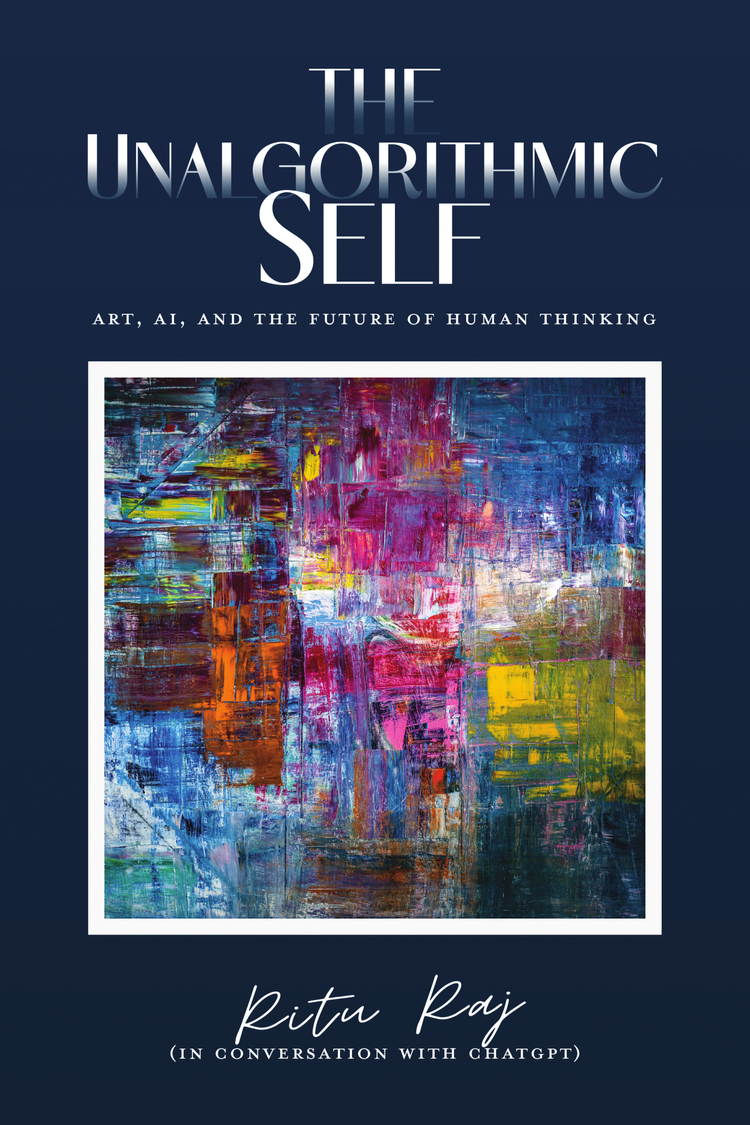
The
Unalgorithmic
Self
Preserving the Human Soul in the Age of Artificial Intelligence
Seventeen chapters on the body, emotion, memory, imagination, vulnerability, and the sacred — the dimensions of selfhood that no machine can replicate.
A machine can answer a question.
Only a human can wonder.
A machine can generate a story.
Only a human can live one.
A machine can predict a pattern.
Only a human can break one.
That line is the self.
This book is a return to it.
— From the pages
“The future belongs not to those who optimize, but to those who preserve the capacity to feel, to falter, and to begin again.”
A machine can produce a sentence about grief without having lost anything. It can write about love without having risked anything. That gap is everything, and it's exactly the gap this book is about.
What I've noticed — in myself, in conversations, in our wider culture — is a slow drift toward measuring human beings the way we measure systems: speed, output, consistency, accuracy, performance. And by those measures, yes, machines exceed us in domain after domain.
But a human life isn't lived in domains. It's lived in what I can only call the thickness of time.
— Why the author
Both sides
of the line.
— Contents
A map of the interior.
Part I
The Human Interior
Chapters 1–9
- 1
The Unalgorithmic Self
What it means to remain human — and why machines can't be selves
- 2
The Body and the Ground of Being
Embodiment as the basis of all meaning — Merleau-Ponty
- 3
Emotion and the Making of Meaning
Emotion as intelligence, not interruption — Nussbaum
- 4
Memory as a Living Reconstruction
Why memory isn't storage — and why machines can't remember
- 5
Imagination and the Human Future
Rupture over recombination — Arendt's natality
- 6
Identity as a Story, Not a Category
What algorithms see, and what they will never see
- 7
Abstraction as a Human Art
Why the abstract painter does something no model can
- 8
Embodiment and Perception
Perceiving from within — vs. processing from outside
- 9
The Sense of Reality
Attention, presence, and what simulation quietly erodes
Part II
The Interior and Intelligence
Chapters 10–15
- 10
Why Machines Cannot Think Like Us
Thought as lived integration — not pattern completion
- 11
The Sacred and the Unquantifiable
What metrics can't touch — and what vanishes when they try
- 12
Consciousness and the Inner Light
The irreducible “someone” behind experience — Heidegger
- 13
Vulnerability as the Essence of the Self
Why only what can be hurt can truly love — Levinas, Jonas
- 14
The Collapse of Uncertainty
Prediction as a threat to freedom, creativity, and becoming
- 15
The Soul in the Age of Intelligence
Soul as depth, not complexity — what no system can enter
Part III
The Unfolding Self
Chapters 16–17 · Afterword
- 16
Returning to Ourselves
The drift away from interiority — and the return that begins with recognition
- 17
Depth in a Shallow Age
How algorithms compress complexity — and what to protect
- +
Afterword: AI Sharpens These Truths
Why the mirror AI holds up clarifies, rather than diminishes, the human
- Publisher
- American Real Publishing
- Structure
- 17 chapters · 3 parts
- Status
- Forthcoming · 2026
- Companion volume
- The Shape of Seeing
— Philosophical companions
Thinking together across time.
Heidegger
1889 — 1976
Dasein · Being-in-the-world
Human existence is not a mind floating above life but an embodied presence immersed in time, care, and relationship. We are the beings for whom existence is always already at stake.
Arendt
1906 — 1975
Natality · Action · Plurality
What defines humanity isn't intelligence but the capacity to begin — to initiate something whose outcome cannot be predicted. Every person enters the world carrying the possibility of the unprecedented.
Levinas
1906 — 1995
The Face · Ethical summons
Ethics does not begin with rules but with encounter — the face of the Other that calls you into responsibility before you choose it. Machines can detect faces. They cannot be addressed by one.
Nussbaum
1947 —
Emotions as intelligence
Emotions are not noise in cognition but forms of evaluative judgment. Anger recognizes injustice. Grief recognizes the depth of love. To suppress emotion is not to think more clearly — it is to think less humanly.
Merleau-Ponty
1908 — 1961
The body as first interpreter
“The body is our general medium for having a world.” Perception is not passive reception — it is an active encounter between a vulnerable organism and a world that presses back. We do not have bodies. We are them.
Hans Jonas
1903 — 1993
Vulnerability · Responsibility
As technology extends our power, our ethical obligations must deepen to match it. Responsibility arises from fragility — wherever something living can be harmed, a moral demand appears. Machines cannot feel that demand.
— When it arrives
The future belongs to the interior.
Be the first to know when The Unalgorithmic Self is available. Studio notes, excerpts, and private access.
Notify me on release