
The Painting · Six Dimensions
The Taxonomy describes the objectAbstraction Quotient · keystone · 0–5 · how far the work has left representation
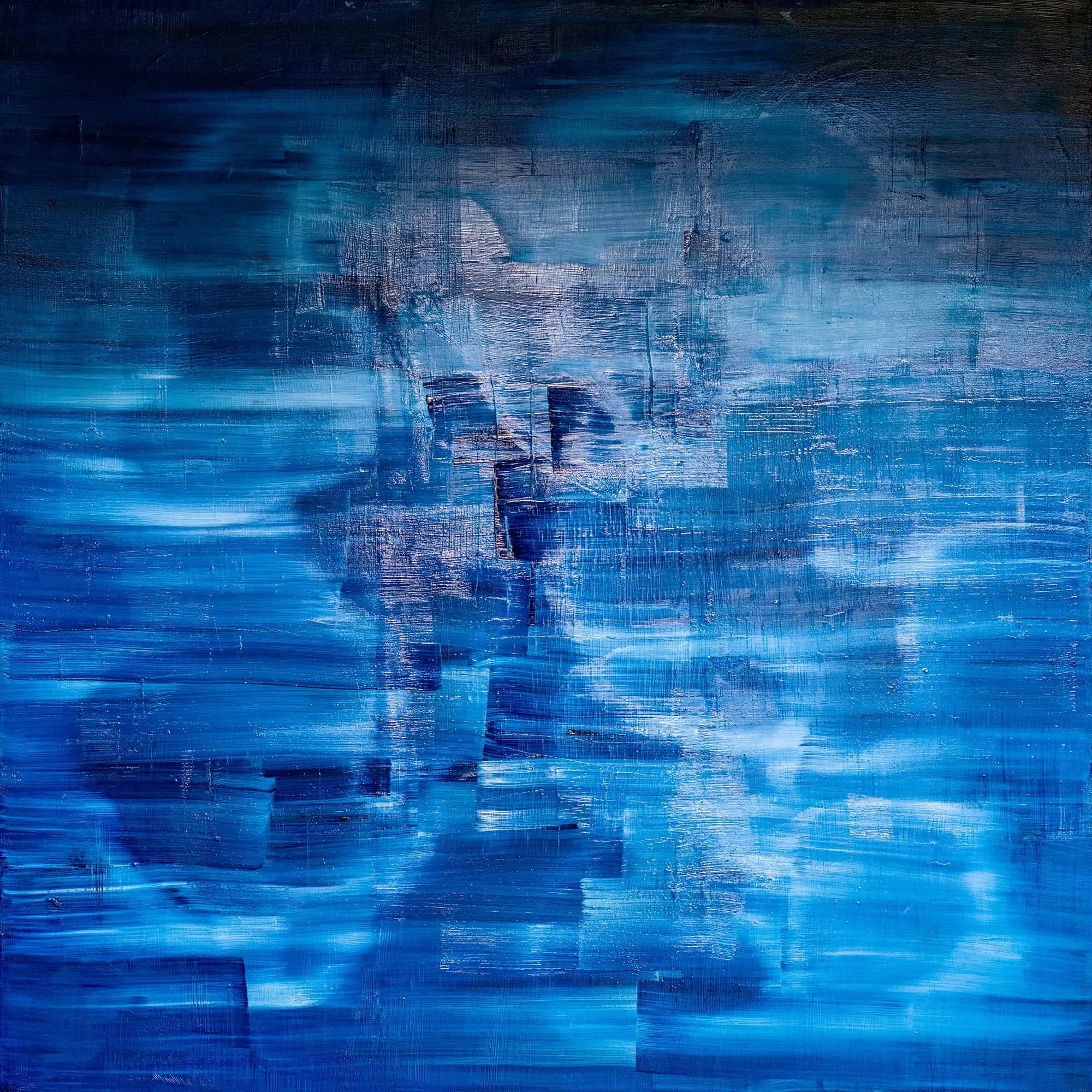
High. Structure is still legible — edges, a suggestion of architecture — but only just, and only for a moment. What the painting depicts is the act of dissolving, not the thing dissolved.
Five dimensions make the shape. The sixth — Palette — fills it, in this painting’s own pigments.
Texture · 0–5
Layered depth — oil built up until the blue has weight, the way water has weight.
Form · 0–5
Form giving way — shapes surface briefly and are taken back by the field before they resolve.
Color Range · 0–5
Navy to pale grey — a single cool family carrying a full range of depth without leaving it.
Palette
Deep Navy · Slate Blue · Steel Blue · Pale Grey
Mood · 0–5 · somber to bright
Theme
Critical Analysis · Abstraction Engine
Submerged Structures is a painting about what remains legible after something has been covered over. Architecture surfaces briefly out of a deep blue field — an edge, a plane, the ghost of a right angle — and is taken back before the eye can name it. The subject is not the structure. It is the water’s patience.
At an Abstraction Quotient of 4 the work keeps just enough structure to make its loss felt. Form sits low at 2, dissolving on purpose; texture sits high at 4, giving the blue the weight of a real depth rather than a color. A single cool family, navy through pale grey, carries the whole range — nothing warm arrives to offer relief.
What lingers is the sense of being alone with something that has not finished disappearing. Not loneliness — depth. The body settles, the breath goes slower, and the eye keeps returning to the places where an edge almost holds.
⊘ Confidence score of 3.2, across 9 logged responses — a moderate, largely shared read.
Six dimensions read the painting. Three read the encounter. The Taxonomy describes the object; ArtGraph is everything beyond it.
The Encounter · Feeling · Emotional Quotient
Confidence Score · from sentiment
How firmly the engine trusts this emotional read. A moderate, largely shared signal — most who stand here arrive somewhere close to the same feeling.
Emotional fingerprint — sunken · quiet · held under · slow light
Space
Where it lives — bedrooms, studies and quiet residential interiors; rooms where slowness is the point.
Transformation
What it does to a room — it lowers the register; conversation quiets near it, and the room begins to feel deeper than it is.
Feeling
Where it leaves you — solitude: alone with something that has not finished disappearing, and comfortable there.
The Encounter · Space · Best Fit · 0–5
The Encounter · Transformation
Submerged Structures lowers the register of a room. Conversation quiets near it, and the space begins to feel deeper than its walls suggest. It rewards a long look and asks nothing of a short one.
For quiet residential interiors, studies, and the collector who reads depth as company rather than absence.
The Work's Own Voice
“Something was there before the water came. I kept letting an edge surface and then taking it back — not hiding it, exactly, just refusing to let it settle into a thing you could name. That is what memory does under enough time. You get the shape of it and never the object.”— Ritu Raj, www.rituart.com/paintings/submerged-structures