The Man Who Walked In
An afternoon in front of Rothko, and the self it quietly took.
Iwant to tell you about an afternoon I cannot fully account for.
I walked into a room of Rothkos as a particular person. I know I was that person because I remember the walk to the door — what I had been turning over in my mind, the small irritations of the day, the version of myself I was carrying in like a coat. I remember arriving. I do not remember leaving as the same man.
The room was dim, the way he wanted it. The paintings hung low, close enough that the colour stopped being something in front of me and became something around me. I sat down. Not to analyse — there was nothing to analyse. No image to enter, no figure to follow, no scene asking to be understood. Only a field of dark red that would not resolve into anything, and would not let me go.
What came next I can only call numbness, and the word is wrong, because numbness sounds like absence and this was its opposite. It was a fullness so complete that the usual machinery — the naming, the judging, the quiet commentary I run underneath everything I look at — simply stopped. Not silenced. Stopped. I sat inside a quiet I had not asked for and could not end.
I do not know for how long. Long enough that when I finally stood, my legs had the stiffness of someone who had been somewhere. I walked out. And on the far side of the door I reached, out of habit, for the man who had walked in — to hand him the experience, to let him make it into a story — and he was not there.
I have looked for him since. I cannot find him. Whoever left that room was near enough to the one who entered to carry his name, his memory, his walk. But he was not the same. Something had been taken, or given — I still cannot tell which — and there was no returning to the door to collect what I had left inside.
I am a painter. It would be convenient, here, to tell you what this means. To fold the afternoon into a theory and hand it to you finished, to say it taught me such-and-such about abstraction. But that would be to do to you the one thing the room refused to do to me. The room did not explain itself. It did not instruct me in how to feel. It made no argument. It changed the person sitting in it, let him leave, and said nothing.
Meaning was never the event. The event was the unmaking.
Rothko never told anyone what his paintings meant. People asked; he refused; I used to think the refusal was difficulty. Now I think it was accuracy. There was nothing for him to explain, because the meaning was never where the painting lived. What lived there was the unmaking — the quiet arriving, the self going loose at its edges, the man who walks out unable to find the man who walked in. He could not put that into words. He could only build the room, dim the light, and wait for you to sit down.
I cannot give you that afternoon. No one can; it does not transfer. I can only tell you that it is available — that somewhere there is a room, or a single canvas on a single wall, that is not waiting to be understood by you, but to do something to you. You do not have to prepare. You do not have to know anything first. You only have to sit down, stay a little longer than is comfortable, and be willing to walk out as someone you cannot yet name.
That is the way of being this painting invites. Not to look. To be changed by looking.
I have stopped looking for the man who walked in.
Whoever walked out is the one who paints.
Ritu Raj · Find your painting →
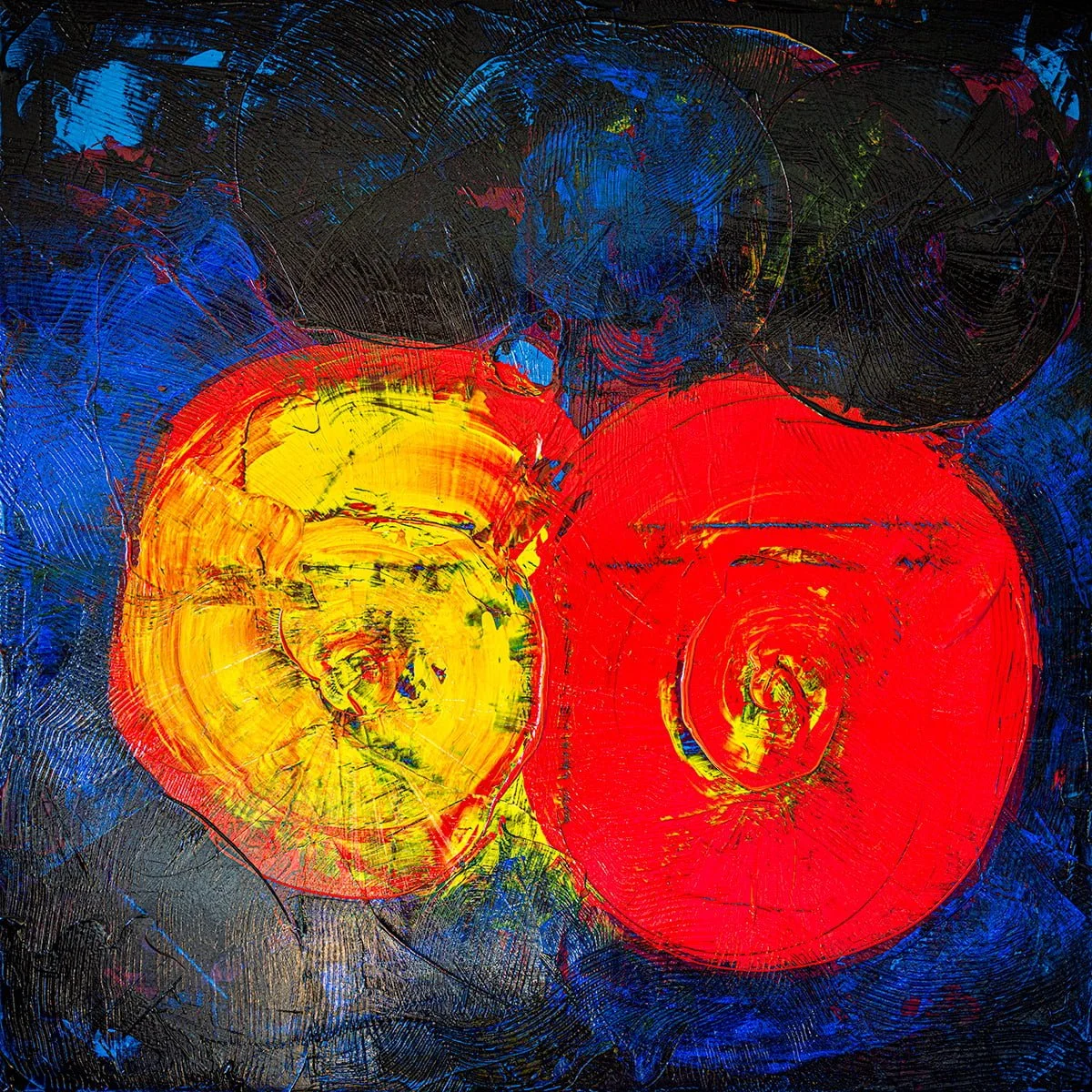
Passage of the Blue