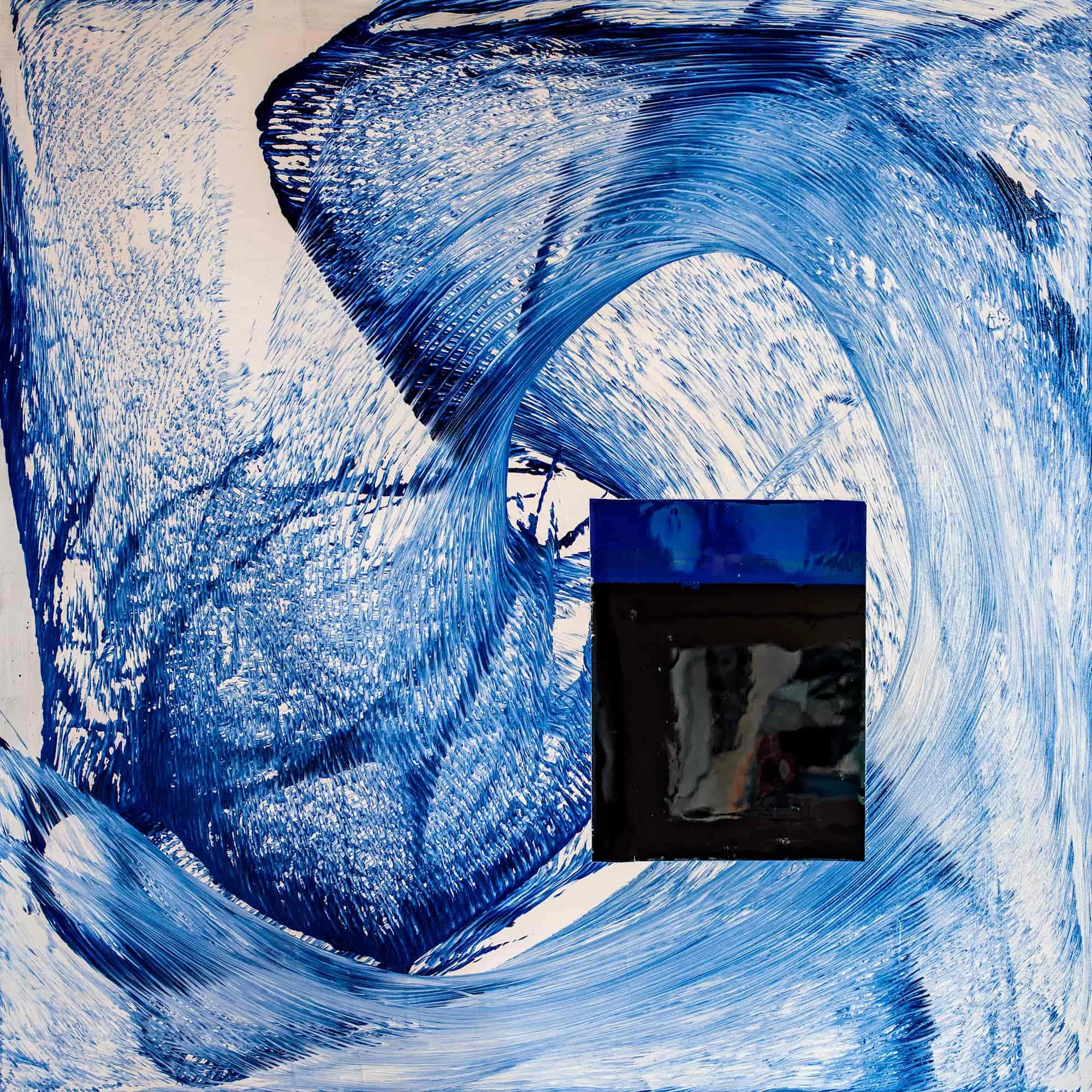
Abstraction as Access
For a hundred years the word abstract has carried a quiet slander. It is heard as removal — the thing drained of warmth, cooled into diagram, lifted off the ground until nothing living remains. Under that hearing, an abstract painting is a subtraction, and the painter is someone who takes the world away. It is the reason "abstract artist" can sound, to the wrong ear, like a confession of distance.
The word never meant that. Abstrahere: to draw forth, to draw toward. Not away from life — into it. Every thinker who has looked at abstraction with real attention has arrived, by a different road, at the same correction. Abstraction is not removal. It is a doorway. Access — to Being, to essence, to the thing underneath the thing. You do not make abstractions the way you make a list. You use abstraction to reach.
Four philosophers map the doorway, and though they never met across their separate centuries, they turn out to describe a single architecture.
Erhard names the ground. Abstraction, he says, is not a concept and not an experience but the context that generates both — dimensionless, prior to form, the condition under which anything can appear at all. This is the studio. The painter does not copy a feeling that already exists somewhere; he becomes the ground the painting arises from. Not the room the image walks into. The source it comes out of.
Husserl names the draw-out. His method strips the empirical clutter away until the essential structure of a thing stands revealed to the inner eye. Bracket the noise; the form steps forward. This is the opposite direction entirely — not generating but extracting, pulling the essential up out of the overgrowth.
Heidegger names the stakes. He warns that abstraction can betray its own promise: lift a hammer out of its use and you are left with weight and shape, a thing concealed in the very act of being described. Reduce a painting to a tag — blue, geometric, mid-century — and you have performed exactly that betrayal. The flat label is the hammer stripped of its purpose. Yet Heidegger also offers abstraction a redemption: the clearing, the open space where things are finally permitted to show themselves.
And here is the one place the lineage has to be refused. Heidegger's clearing is passive — an empty room that waits. The painter declines it. He does not want to be the space where the work appears. He wants to be the source it comes from. That refusal is not a footnote. It is the whole stance: not the clearing, the ground.
Wittgenstein names the humility. The essence has no fixed core you can pin with a word; meaning lives in use, and the deepest things sit just past the edge of what language can hold. This is why a category fails and an encounter works. The painting reaches the unsayable directly, with no word standing in the way.
Lay the four side by side and the old false choice — is the work found or made, drawn out or generated? — stops being a contradiction. Both are access. The floor under everything is not a verb. It is the doorway itself, and the doorway opens both ways.
On the canvas, abstraction is generated. The painter is the ground. Organic Movement is what happens when he stops directing and lets the material find its own logic — paint and thread and gravity arriving at a form that did not exist until it did. Generation, in Erhard's sense. Source.
In the engine, abstraction is drawn out. ArtGraph takes a person who cannot quite say what they are looking for and pulls the essential signal up out of the noise — fluid, breathing, intimate, luminous restraint — and hands it back to them. Extraction, in Husserl's sense. The clutter bracketed away until the real shape stands clear.
Same doorway. Two directions. The painter generates it on the canvas; the engine draws it out of the person. One reaches the unsayable by making it. The other reaches it by listening for it. And the two faces turn out to be one obsession in different work clothes: art that listens, and people who are, at last, heard.
That is the whole of it. Not a technique anyone could walk out of — a relationship to the real, run both ways from a single doorway. The painter stands in it and generates. The collector stands in it and is drawn out. Neither one is removal. Both are the way in.