What Rothko Could Only Do With a Dimmer Switch
The case against the object — a section for A Taxonomy of Abstraction
Mark Rothko spent the last decade of his life refusing to be sorted.
Call him a colorist and he would correct you — he had no interest, he said, in the relationships between colors. Call him an abstractionist and he would bristle at that too, because that label also sorted him by what his paintings were rather than what they did. He did not want to be filed under a movement, a palette, a technique. What he wanted — what he said, again and again, to anyone who would listen — was for you to stand in front of the canvas and have something happen to you. He wanted the work sorted by the encounter.
He was right. He was right decades before anyone had the language to agree with him.
But watch what he did with that rightness, because it is the whole problem in miniature. Having rejected every available way of describing his work, Rothko was left with nothing to describe it with. So he stopped describing and started controlling. He hung the paintings low, close to the floor, so they would loom. He demanded dim light. He asked that people stand near — eighteen inches, close enough that the color filled the whole field of sight and the edges of the room fell away. He built a chapel. Every one of these decisions is a man protecting the encounter with his bare hands because he had no word for it. Installation standing in for description. A carefully darkened room doing the work a sentence could not do.
That is where the language runs out. Not with a lesser painter — with the greatest painter of the encounter we have. He could say not color, not form, not meaning. He could say no. And then he reached for the dimmer switch, because no was the entire vocabulary he had been given.
This is the quiet failure at the center of every way we sort abstraction. Each one describes the painting and calls it finished.
Consider them.
Sort by color and you have catalogued what sits on the canvas — the reds, the veils, the temperature of the ground. You have said nothing about what happens in front of it. Two people stand before the same red. One steadies. One comes undone. The red is identical; the encounter is not. Color tells you what the painting has, never what it does.
Sort by style — Color Field, Abstract Expressionism, the long lineage of gesture — and you have placed the painting in a family. You have traced where it came from. You have said nothing about where it takes the person standing there. Style is genealogy. It reads the object's ancestry and stays silent on the encounter's future.
Sort by emotion — this one is melancholy, that one ecstatic — and you have done something subtler and worse. You have taken a feeling that lives between the person and the painting and pinned it to the canvas, as though it were a property of the pigment. But the feeling was never in the painting. It was in the meeting. Tag the object with it and you erase the person entirely.
Sort by art history — influence, chronology, the argument each canvas makes with the canvases before it — and you have described a long conversation among paintings. A real conversation, and a beautiful one. But not the conversation that matters here: the one between the painting and the single human being standing in the dark in front of it.
Sort by meaning — what does it represent, what is it about — and you have committed the founding error, the one abstraction exists to refuse. You have treated the painting as a container for a message to be decoded. Abstraction's whole gesture is to stop being a container. To ask what it means is to arrive already having missed it.
Five ways of sorting. They look like five different tools. They are the same tool, used five times, failing the same way. Each reaches for the encounter and comes back holding the painting. Each describes, with real care, the wrong half.
And now the dimmer switch makes sense. Rothko was not being difficult, or precious. He had diagnosed the failure with perfect accuracy — you are all describing the object, and the object is not where I live — and he had no other half to hand you. So he built rooms. He controlled the light. He staged the encounter he could not name, the way you might hum a melody you have no words for, trusting the other person to catch the tune.
What if you did not have to hum it?
What if the encounter — the part that changes from person to person, the part Rothko could only guard with darkness — could itself be described? Not reduced. Not solved. Described, with the same care we have always spent on the object.
That is the whole of what follows. Six dimensions read the painting: its texture, its form, its colour range, its palette, its mood, and the abstraction quotient that governs them all. Three dimensions read the encounter: the space it opens, the transformation it works, the feeling it leaves. The first six describe what Rothko was tired of hearing about. The last three describe what he spent his life protecting and could never say.
The Taxonomy describes the object. Everything beyond it describes the meeting. Rothko already knew the meeting was the point. He simply died before there was a word for it.
This is not a correction of Rothko. It is the completion of a gesture he could only make by refusing — the sentence he reached for every time he dimmed a room.
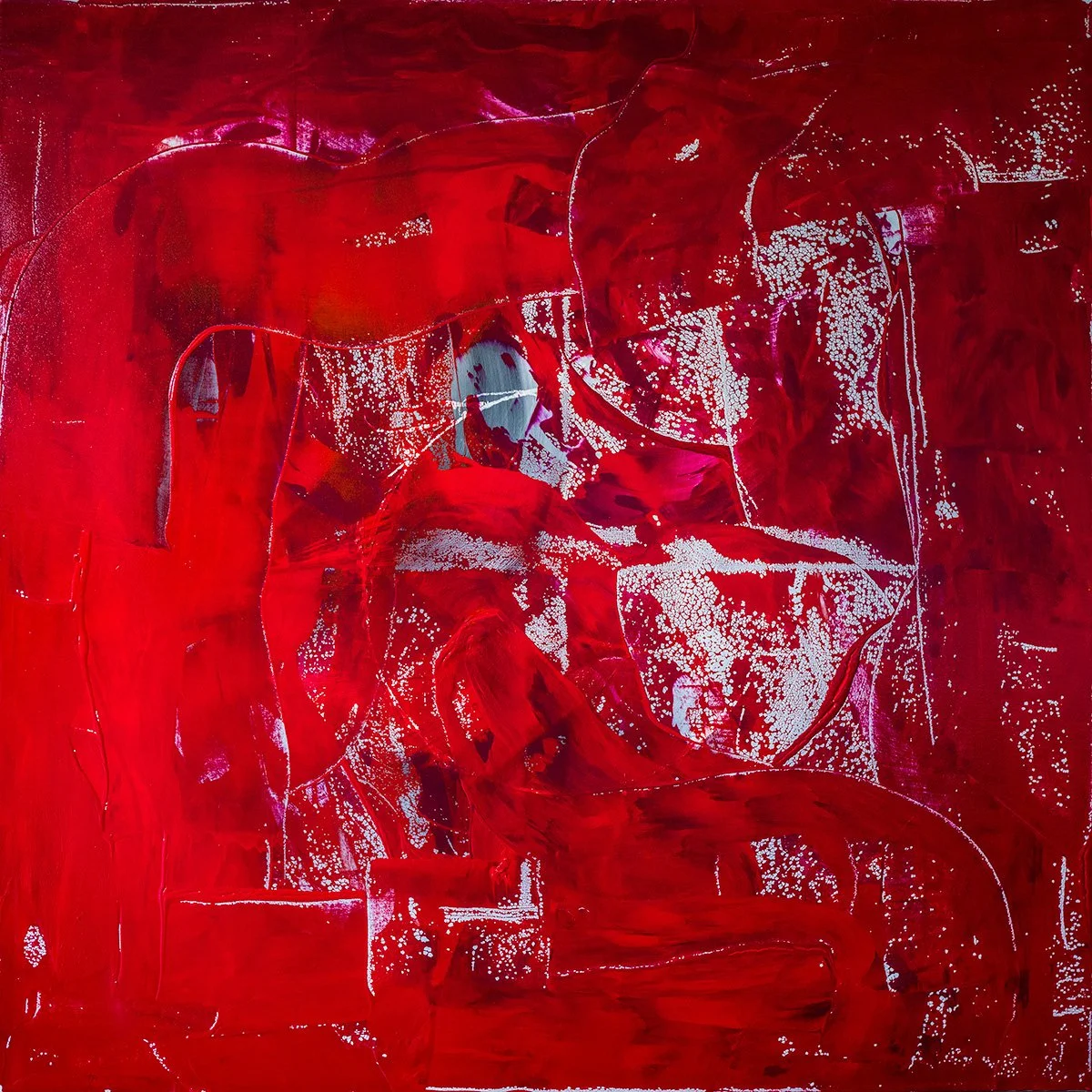
Emergent Ground in Red