Almost nobody in the art world will explain pricing to you, which is exactly why it feels arbitrary — and why so many people quietly assume they are being tested. They aren't. There is arithmetic underneath, and I would rather show you mine than have you guess at it.
Size does most of the work, and it isn't only about materials.
A large canvas costs more to stretch, prime, and ship, but the material difference between a small painting and a large one is a rounding error against the price of either. Size matters because of what it does to the making. A painting five feet across cannot be resolved from a seated position. You work standing, stepping back, walking the room, losing the whole thing to gain a corner. The failure rate is higher and the failures are more expensive, because a large canvas that doesn't come together has consumed weeks.
So: size correlates with price primarily because it correlates with risk and time. Most artists price by the square inch as a starting point, then adjust. I do too. It is a starting point, not a verdict.

Sunken Forest · Acrylic on canvas · 6 × 5 ft · 2026 · $15,000
Time is real but misleading.
People sometimes ask how long a painting took, hoping to divide the price by the hours. It is a fair instinct and it produces bad numbers. Some paintings arrive in two sessions. Others take eight months, mostly spent not painting — turned to the wall, waiting for me to understand what was wrong with them.
What you are paying for isn't the hours in front of that canvas. It is the twenty-five years that made those two sessions possible, and the paintings that failed so this one wouldn't. A painting that came quickly is not a discount. It is usually a sign that everything before it worked.
Materials matter more than people expect.
Artist-grade pigment is priced by the pigment, and the difference between a student cadmium and a real one is not subtle — in cost, in behavior, or in how it looks in thirty years. Linen costs multiples of cotton duck. Archival varnish, proper stretcher bars for large work, professional crating. On a large painting, materials can run into four figures before the first mark.
This is also where a great deal of inexpensive "original abstract art" quietly falls apart. The price is honest about what it is. It just isn't buying you decades.
Then there is the gallery, which is the part nobody explains.
When a painting sells through Jarrow & Goodman, the gallery takes a share — this is standard, it is roughly half, and it is entirely fair. That share pays for the space, the lighting, the shipping, the fairs, the insurance, the staff, and the years of showing work that doesn't sell. A gallery carries an artist through the dry seasons. That is what the commission buys.
The consequence for you is this: a painting cannot be cheaper in the studio than it is in the gallery. Ever. If it were, no gallery could afford to represent anyone, and the artist would be destroying the thing that sustains them. When you buy directly from me, the price is the same. What differs is the conversation, not the number.
Why two similar paintings have different prices.
Because they are not similar in the way that matters. One may be from a body of work that has been exhibited and written about; the other may be a fine painting that sits outside any developed line of thinking. One may be a resolution the artist searched three years for; the other a variation made confidently a month later. Provenance, exhibition history, and where a work sits within a body of work all move price, and none of them are visible from across the room.
Ask. The answer should be specific. If it isn't, that tells you something too.
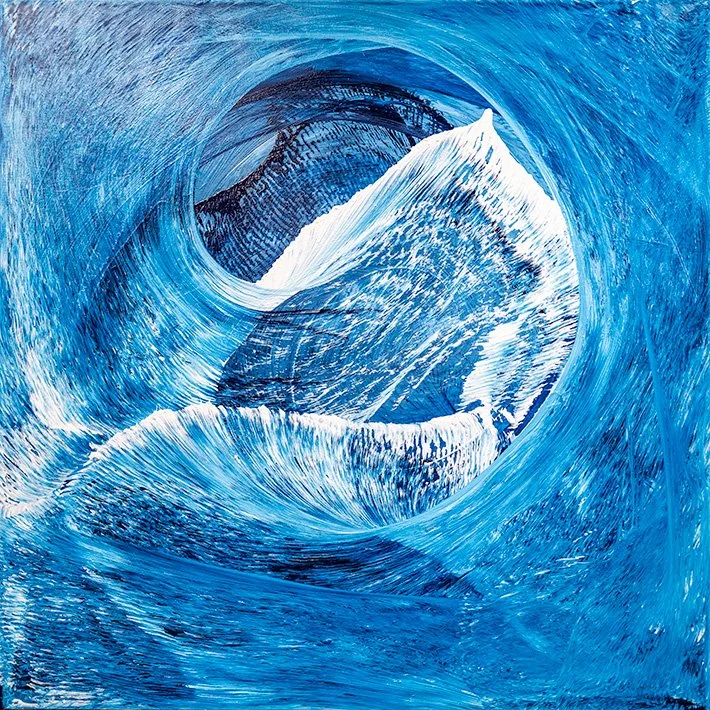
String Wave · Oil on canvas with thread · 4 × 4 ft · 2025 · $8,000
And where reputation comes in — honestly.
An artist's record does affect price, and it is the component with the least to do with the object in front of you. Exhibition history, institutional attention, auction results, critical writing: these are the market's way of pricing confidence in the future. They are real, they are legible, and they are also the part most likely to be inflated by people with an interest in inflating it.
My own position on this is unsentimental. Record should support a price. It should never be the whole of it. If someone can only tell you why a painting is expensive by listing where the artist has shown, you are being sold a résumé.
What price does not tell you.
Whether it is good. Whether it is good for you. Price is a reasonably honest signal about scale, materials, and market confidence, and a poor one about everything that will actually determine whether you are glad you bought it in five years.
Which is a different question, and I have written about it separately.