Journal · Collector Guides
Why Does a Painting Look Different in Person Than on a Screen?
Sindoor Field, six feet of red, and what a photograph cannot carry
A screen shows a painting in one light, at one size, with no surface. In a room, the painting's scale holds your whole body, its texture catches light that changes through the day, and small shifts of color that a camera averages away become visible. That is why a painting seen in person is never quite the same painting twice.
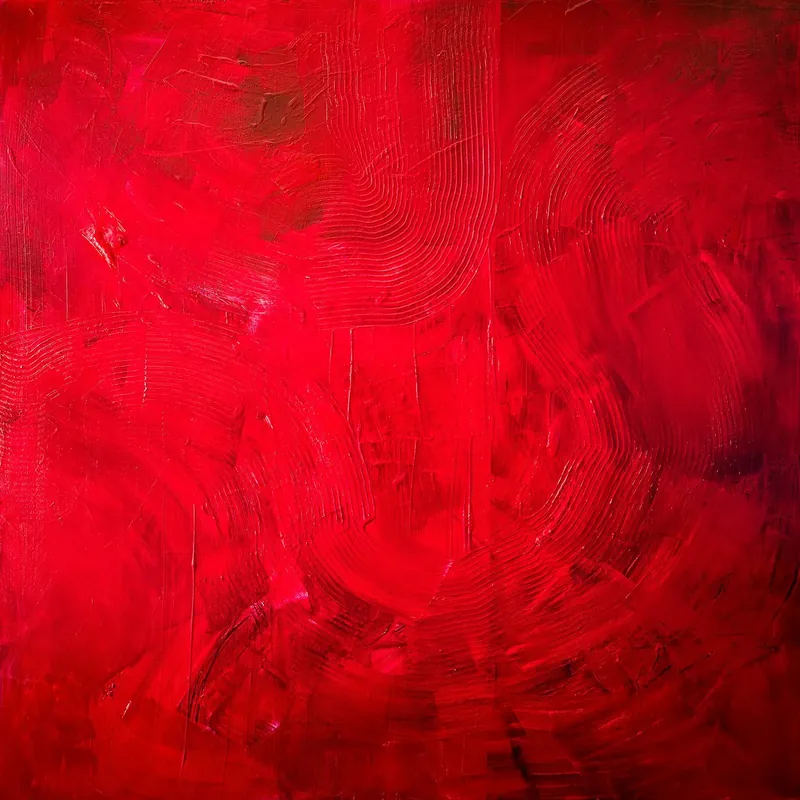
The painting above is red. Not mostly red, not red with a few other things happening in it. Red, from edge to edge, six feet by six feet. On your screen it is a red square. In my studio it is something I cannot stop looking at, and I made it.
Sindoor is the vermilion powder of India: the red a married woman wears in the parting of her hair, the red pressed onto the forehead and offered to the gods. It is never one red. It changes with the skin it sits on, the light it is seen in, the hour of the ceremony. I named the painting for that.
Six feet of one red
Several reds went into Sindoor Field: carmine, crimson, vermilion, rose madder, maroon, oxblood. One red came out. But inside that one red, the others are still there, moving against each other in shifts so small that you feel them before you can name them. That movement is the painting. It is why a six-foot field of a single color does not tire the eye. There is always somewhere for the eye to go next.
A camera cannot hold this. A photograph decides on one red and averages the rest into it, and saturated reds are where cameras and screens struggle most: the fine steps between one deep red and the next flatten out, and what was a field turns into a fill. You are not seeing a worse version of the painting on your screen. You are seeing a different, simpler object that happens to share its outline.
Texture is a clock
Under the red is a surface I laid down years ago with a notched trowel, the tool tilers use to comb adhesive before they set a tile. The ridges snake across the whole canvas. When I painted over them in oil, the paint did what oil does: it pooled in the low places and thinned across the high ones, so the same red reads dark in the valleys and light on the crests.
Now add the room. At nine in the morning, low light rakes across the ridges and every one of them throws a shadow. By midday the light falls flatter and the surface settles into color. Toward evening, under lamps, the high points catch and glow. It is not the same painting at nine and at four. A photograph freezes one of those hours and calls it the painting.
Scale is a body
On a phone, Sindoor Field is a few inches wide. In a room it is taller than most people. A painting that size is not seen the way a picture is seen, from the outside. It fills your field of vision, so your eyes have to travel across it, and the traveling is part of what it does. Your body knows the difference even when your mind is busy. A thumbnail asks you to judge. A six-foot red asks you to stay.
So how do you choose a painting you have only seen online?
Use the screen for what it is good at: finding the paintings worth seeing. Then see them. Come to RituStudio in Phoenix, by appointment, and look at the work at different hours if you can. If you cannot travel, every painting on rituart.com can be returned within 14 days of delivery, and shipping is included within the United States, so you can see it where it will actually live: on your wall, in your light, at your hours. More practical answers are on the questions page.
And if you want a way in that is not a grid of thumbnails, Find Your Painting starts from a feeling, or a room, rather than from a picture.
Whatever you see on a screen, the painting is still waiting to be seen.