Journal · Studio Voice & Philosophy
The Real Danger of AI Isn't That Machines Will Think Like Us
It's that we may begin to think of ourselves as machines.
Most of our public conversation about artificial intelligence turns on a handful of questions. Will machines think like us? Will they become conscious? Will they surpass us? Will human intelligence stop being exceptional? These questions matter, and some may stay open for generations. But I have come to worry about something quieter, something that needs no breakthrough at all.
What if, long before machines learn to think like us, we learn to think of ourselves as machines?
It has been happening for decades. We call our minds processors, our memories storage, our choices calculations, our identities a set of measurable attributes. We optimize our lives, maximize our output, manage our emotions. Even self-improvement now sounds like systems engineering, as if the central task of being human were to remove the inefficiency.
AI did not invent this way of thinking. It gave it authority. As machines take on work we once believed only minds could do, we are tempted to measure ourselves against them. If an algorithm can write an essay, why write? If a system can make an image, what is creativity for? If a model can give advice, what is judgment?
The risk is not only that machines will take over particular tasks. It is that we will mistake those tasks for the whole of a life.
When intelligence becomes performance
I have spent decades in mathematics, computing and building companies, fields in which measurement, prediction and optimization are indispensable. I love what abstraction does in mathematics, the way a good system turns complexity into something you can hold. A well-made algorithm is beautiful, the way a proof is beautiful.
But a method that succeeds in one domain is not a key to every door. A system is judged by how well it predicts or how efficiently it finishes. A person cannot be judged that way. We stay loyal when loyalty costs us. We chase questions that have no practical answer. We make choices that look irrational until you know the history they came from.
We do not only calculate what is possible. We care about what matters.
Think of the difference between knowing that someone is grieving and understanding what grief does to a life. A system can recognize the language of bereavement and answer with something comforting, and that has value. But grief is not a pattern of words. It is a world rearranged by an absence. It changes the meaning of a familiar street, an ordinary Tuesday, a memory that once seemed settled.
Human intelligence happens inside experiences like that. It is shaped by having a body, a history, attachments, fears, and a future we care about. Define intelligence as the production of correct outputs and you lose sight of what makes human thinking matter.
The body is not an accessory
One argument that runs through The Unalgorithmic Self is that we do not think apart from our bodies. We are not detached processors taking in data and emitting decisions. We meet the world through sensation, movement, feeling, and the plain physical fact of being alive.
A room feels different after an argument, though nothing in it has moved. A street becomes hard to walk down after someone you loved is gone. A song returns you to a year you had forgotten you remembered. These are not glitches in rational processing. They show how tightly perception is braided with memory, emotion and flesh.
The body is not a container that happens to hold a mind. It takes part in the thinking.
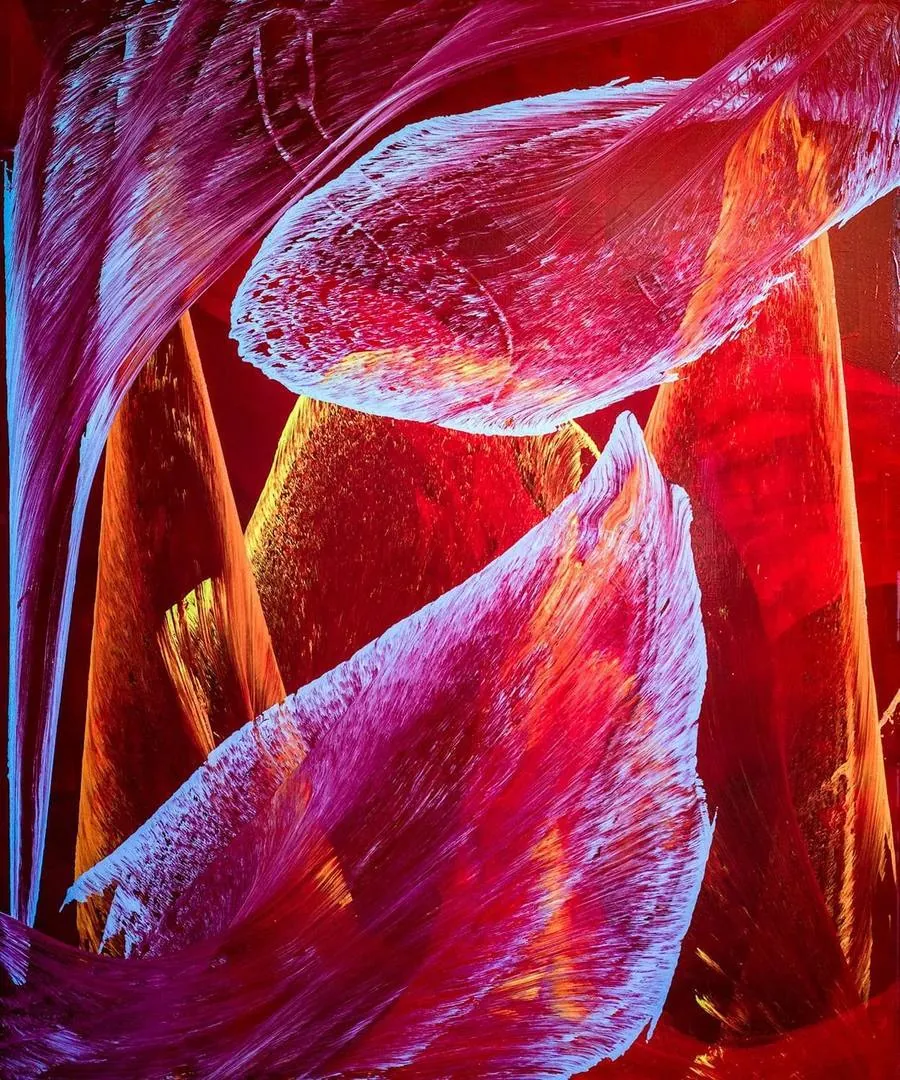
I feel this most plainly in the studio. I paint with thread drawn through wet oil, and the painting does not travel from my head to the canvas. The width of the canvas changes how my arms move. The drag of the paint changes the line. Fatigue, focus, the half second of not knowing where the thread will go: all of it decides with me. The thinking happens in the doing.
Maurice Merleau-Ponty grounded perception in the body's engagement with the world. Martin Heidegger described human existence not as a mind looking out at objects, but as a being already caught up in a world that matters to it. Both feel newly relevant, because AI has revived an old temptation: to equate intelligence with the manipulation of symbols.
AI can model aspects of embodied behavior. But a model of a body is not the experience of living in one, vulnerable, aging and mortal. That experience changes what it means to think.
Memory is not a database
The computer metaphor misleads most badly when it comes to memory. We imagine a store of records, fetched on demand. That describes certain machines well. It does not describe remembering a life.
A childhood memory changes as we age. Something that seemed trivial becomes important decades later. We remember a parent's face differently once we have lived through what they lived through. We reread an old decision in the light of consequences we could not see at the time.
Memory is not the retrieval of an unchanged file. It is an ongoing relationship between the past and the person we have become. That is why identity cannot be reduced to a profile.
A system can gather a staggering amount about us, our purchases, habits, relationships and choices, and predict our next move with uncomfortable accuracy. But predicting what someone will do is not understanding what their life means to them.
We are not only what we have done. We are also what we regret, what we refused, what we hope for, what we are still finding out. A human identity is unfinished. An algorithm can trace the pattern we have lived. It cannot, by tracing it, decide what we become.
The seduction of predictability
Modern technology is remarkably good at reducing uncertainty. We can anticipate traffic, catch fraud, detect early signs of disease, and model systems too complex for any one mind. These gains are real, and some of them save lives.
But uncertainty is not only a defect. In a human life, it is also where possibility lives. We fall in love without knowing how it will go. We start a painting without knowing whether it will work. We begin a hard conversation without knowing what the other person will say. We keep a promise with no guarantee that keeping it will pay.
A life without uncertainty would not be a safer version of a human life. It would be a different kind of life. Courage is acting without knowing the outcome. Freedom is imagining a future that does not follow neatly from the past. Discovery is staying with a question that has not yet been answered.
Yet much of our technological environment is built to make uncertainty disappear. Recommendation systems guess what we want. Predictive systems estimate what we will choose. Platforms arrange our experience around patterns drawn from what we did before.
The result is a narrowing that feels like convenience. Offered only what resembles our past, we meet less that might change us. Predicted constantly, we begin to see ourselves in the categories that make prediction possible. Handed an optimized answer for every choice, we lose faith in the slower, riskier work of judgment.
Prediction is useful. The question is whether we can still tell the difference between predicting a person and letting a person remain free.
What happens to the self
The deepest worry behind The Unalgorithmic Self is not that AI will become extraordinarily capable. I expect it to, and much of what it does will widen what people can do. My worry is that we will grow comfortable describing ourselves in the logic of the systems we build.
We may start mistaking attention for engagement, relationships for networks, identity for a profile, creativity for content, meaning for measurable impact. We may treat emotion as noise, uncertainty as failure, and reflection as lag between input and output. In that world, the self becomes something to manage instead of something to live.
But a person is not the sum of their observable behavior. There is an inner life through which that behavior means something: memory, imagination, vulnerability, the strange capacity to ask what our own life is for.
That inner life is hard to measure, which may be exactly why it needs protecting. Love, once scored, is no longer quite love. Dignity cannot be read off a prediction. The worth of a life cannot be computed from its productivity.
The unfinished self
I don't want AI rejected because it unsettles our assumptions. Nor do I want to defend humanity with ever shakier claims about what machines will never do. That would leave human worth hostage to the limits of technology.
The more important choice is philosophical, not technical: which picture of the human being will guide what we build. If we treat ourselves as information processors, we will build a world organized around prediction and performance. If we understand ourselves as embodied, remembering, unfinished beings, we may build tools that leave room for that.
In the studio there is always a moment before the thread touches the paint, when I don't yet know what the line will do. Everything I have made began in that moment. I would like to keep a little of it in the rest of life, too: a door no system has opened for me in advance, and a self that no one has finished predicting.
Keep reading