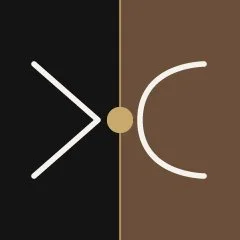
A Mark That Listens
Listen. Transform. Abstract.
When a Hindu child is born in India, the exact time and place of birth is given to a Vedic astrologer. He reads the stars — not metaphorically, but precisely, mathematically — and from the position of the sky at that moment, he derives a sound. A single phoneme. The first sound of the child's name.
This is not naming. This is assignment. The sound precedes the person.
When I was born, the astrologer derived ऋ — the Sanskrit vocalic R, one of the oldest phonemes in the language. My parents named me Ritu. They could have named me Rishi, or Ritesh, or any of the names that begin with that sound. They chose Ritu — which in Hindi means seasons. My full name, Ritu Raj, means the king of seasons.
I have carried this sound my entire life without fully understanding what it meant to carry it.
In Sanskrit, ऋ is not a consonant with a vowel attached. It is not constructed from parts. It is a self-contained sound — a vocalic R that appears in the Rigveda, that exists in both Sanskrit and ancient Chinese, that predates the branching of those language families into the forms we recognize today. It is a sound that arose before language organized itself into meaning.
Marks have meaning, given by language. Sometimes given before the person who will carry them has drawn a single breath.
This is the origin of the RituArt mark.
What a logo is supposed to do
I had a logo. It had a hand, a spiral, a gold circle. It was intentional. People responded to it. But when I held it against everything rituart.com has become — the Taxonomy of Abstraction, the Recommend a Painting engine, the two bodies of work, the philosophical position that art listens before it speaks — it felt like a symbol of craft rather than inquiry. A hand offering something. Generous, but facing the wrong direction.
A mark that represents this practice needed to face inward. Receptive, not expressive. Open, not extended.
I started over.
Three acts
The breakthrough came when I stopped trying to design a logo and started trying to describe what happens in the studio.
Three things happen, in sequence, every time:
Listen. Before anything touches the canvas, there is a period of attention that has no object. Not listening to music, not listening to reference, not listening to intention. Listening to what the work wants to become. This is not mysticism. It is discipline. The painting has a logic before I do.
Transform. Something passes through. I am not the origin of what emerges — I am the condition for its emergence. The transformation is not mine to claim. It happens at the threshold between attention and action, in a place I cannot see directly.
Abstract. What arrives has been freed from its literal form. The thread follows gravity. The oil follows viscosity. The acrylic follows time. What remains is not a representation of something — it is the thing itself, in its most essential form.
Three acts. One mark.
The geometry
I broke ऋ into its components.
Without its header stroke — the horizontal line that marks it as a Sanskrit letter — the form becomes something else. A symbol that carries the origin without declaring it. Unfamiliar to Western eyes not as "a foreign letter" but as a form with its own gravity.
What remained were three gestures:
A chevron pointing right. The channel. Something enters.
A vertical line with a gold point at its center. The transformation. The threshold. The place you cannot see.
A C. The receiving form. Open. What emerges rests here.
I drew them separately on a page in my notebook. Three squares, each holding one act. Then I asked what happened when they collapsed into one.
The answer was a split circle and a split square — the container divided vertically, dark on the left, umber on the right, a gold seam at the center. The chevron in the dark half. The C in the warm half. The gold dot at the seam, touching neither form, belonging to both.
The gap between the chevron tip and the C opening is where the transformation lives. You cannot see it. That is the point.
Why the container splits
The division is not decorative. It is the argument.
Dark receives. Warm holds. The gold is the moment between them.
In the circle, the mark travels — Instagram, embossed on a card, wax seal on a shipment. The circle belongs to no grid. It floats.
In the square, the mark radiates authority. A painting on a wall. A name on a building. A colophon on the back of a canvas.
Same mark. Two registers. One gold seam.
What ऋ means to carry
My father, K.B. Goel, spent his life in the company of marks. He wrote about Souza, Husain, Swaminathan — artists whose work he believed carried something that could not be explained, only encountered. He understood that the visual is a form of knowing that precedes language.
I grew up watching him look. Not analyze. Look.
The sound ऋ is what looking feels like before it becomes seeing. It is the sound of attention before it has an object. Which is exactly what this practice is — and exactly what I want this mark to carry into every room it enters.
Not: here is what I made.
But: here is what I listened for.