Rangoli in Permanence
Share this painting
Copy the text below to send via message, email, or WhatsApp.
My father was one of India's foremost art critics. Growing up in New Delhi, our home was full of paintings — Souza, Husain, Swaminathan — but the first geometry I ever absorbed wasn't on any wall. It was on the floor.
Rangoli is drawn at thresholds. Temple courtyards in the early morning, the color still damp. The front step of a home at Diwali, a woman working freehand with colored powder, her hand moving with the confidence of something practiced across generations. The patterns are geometric — nested squares, concentric diamonds, symmetrical forms that pull the eye inward toward a center — and they are made, always, to be temporary. The festival ends. The powder scatters. The threshold becomes just a floor again.
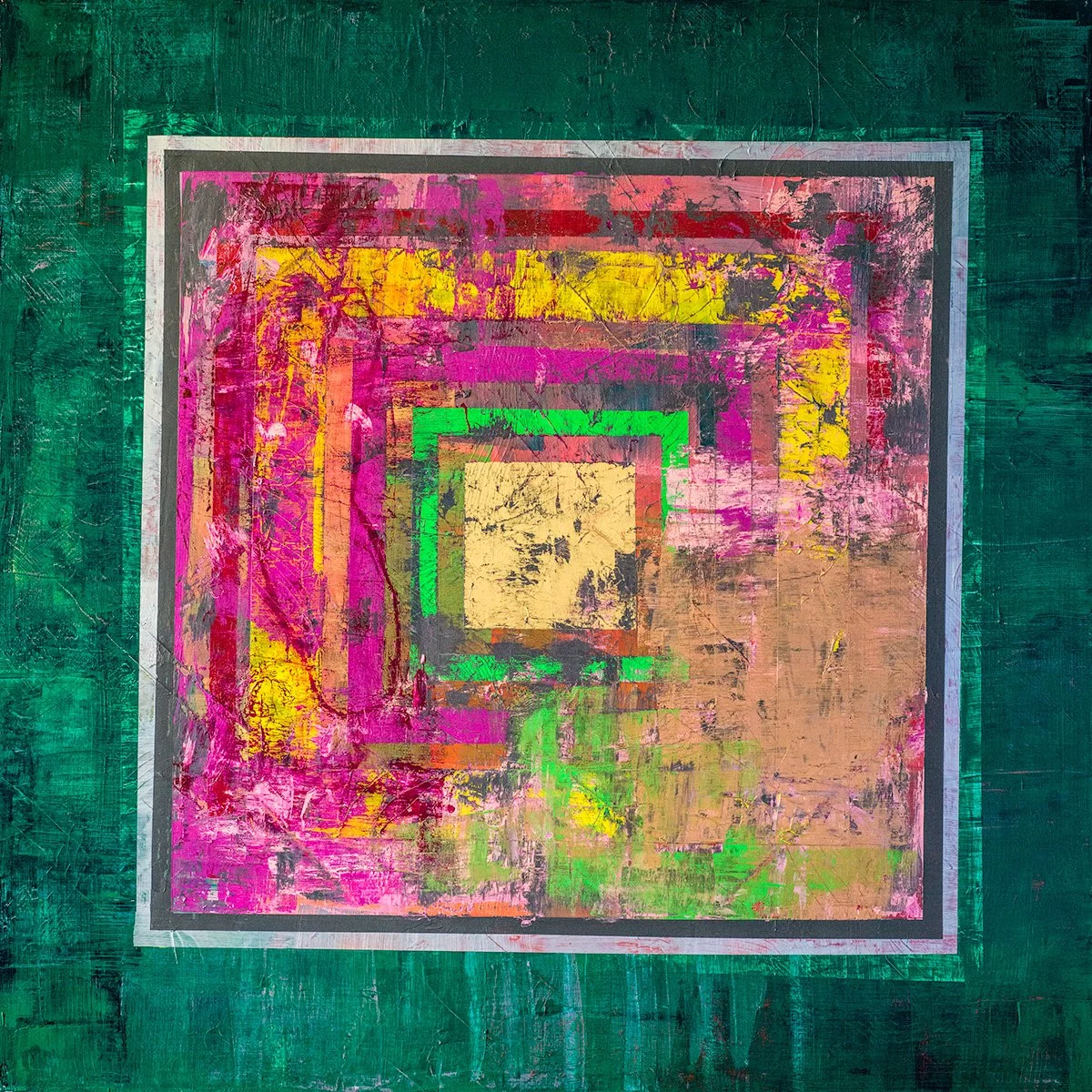
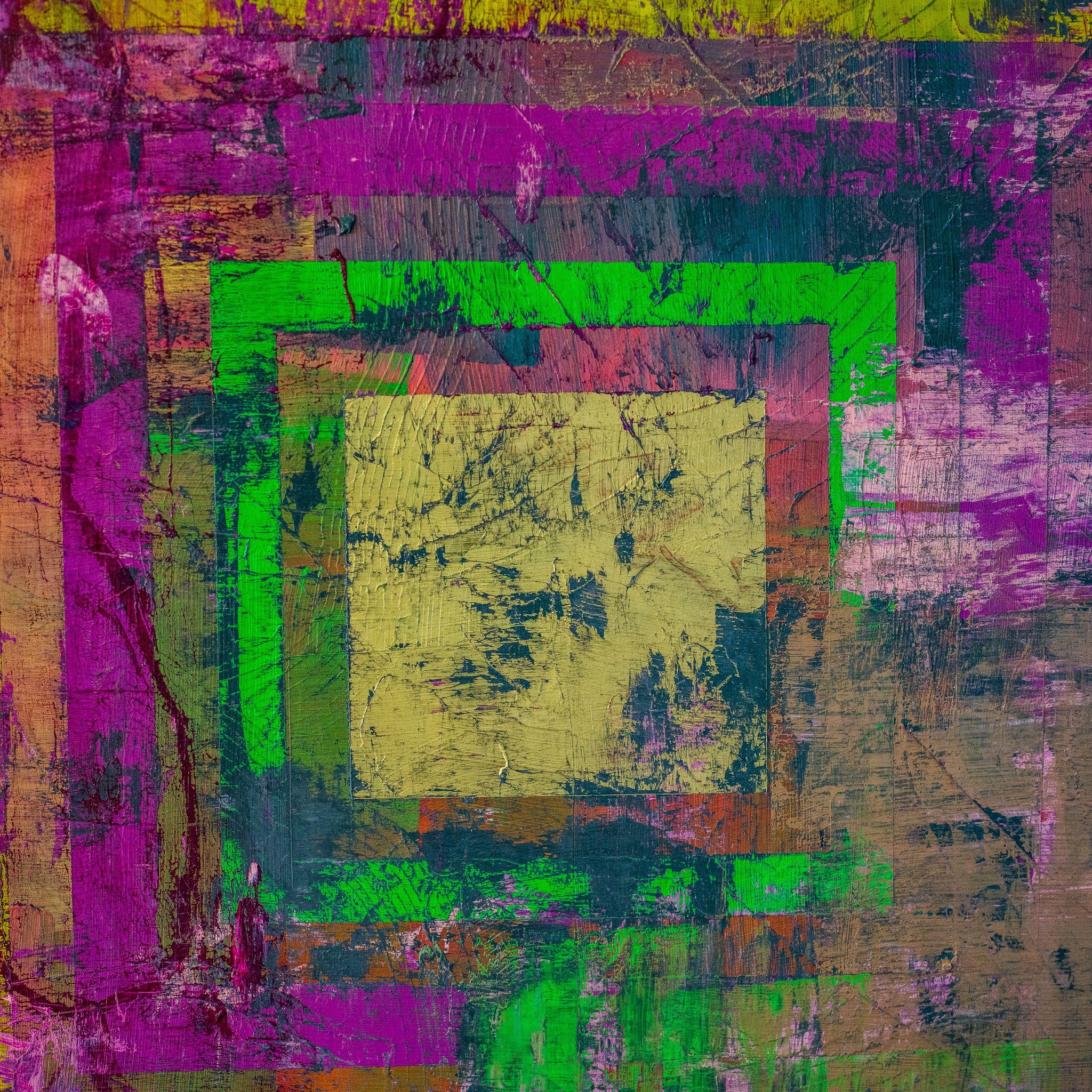
I didn't set out to paint rangoli. But when this work came together — the deep malachite field, the magenta pressing against gold, the nested squares tightening toward a worn and weathered center — I recognized what I had done. I had tried to hold a rangoli still.
Rangoli in Permanence is that act of holding. The geometry is precise, but the surface carries the memory of impermanence — paint dragged and layered and revised, the center almost excavated, as if time had already begun its work. The neon green at the innermost ring has the electric quality of fresh powder before it fades. The outer emerald field is the courtyard, the morning, the space the pattern exists within.
This is also where the yantra lives — the sacred geometric diagram used in Hindu and Tantric practice as a tool of meditation and devotion. Where rangoli is domestic and festival-bound, yantra is temple and contemplative. But they share the same impulse: geometry as a technology of attention, nested form as a way of drawing the mind inward. The two traditions have always existed in the same culture, the same household, different registers of the same understanding that shape can be a form of devotion.
I think of Gerhard Richter here — specifically his squeegee works, where the tool becomes agent and the painting bears the visible evidence of its own making. Richter understood that a surface could hold more truth when it didn't erase its process. The worn quality of this center is not accident. It is the painting acknowledging that it was made by a hand that has lived inside a tradition it can never fully fix or finalize.
I also think of the architect Diébédo Francis Kéré, who builds with indigenous Burkinabé form embedded in contemporary structure — two sets of knowledge held simultaneously, neither collapsing into the other. Rangoli in Permanence lives in that same tension. The Indian geometric inheritance is real and specific. So is the debt to Rothko's understanding that color can be a room you inhabit rather than a surface you observe. The deep emerald exterior is not background — it is atmosphere. You don't look at it. You stand inside it.
What the painting asks, finally, is what it means to make permanent what was designed to dissolve. Rangoli is an offering. It exists in the giving and the fading. Fixing it in acrylic on canvas is an act of devotion and an act of resistance at once — a refusal to let the threshold disappear, a refusal to let the festival end.
The collector who lives with this work lives with that threshold. Sacred and domestic. Ephemeral and permanent. Every frame crossed reveals another. That is not the painting failing to resolve. That is the painting working exactly as it should.
Rangoli in Permanence, 2026. Acrylic on canvas. 5 × 5 ft. Part of the Abstract Inquiry and Geometric Splendor collections. Available through rituart.com