The Painting That Refused to Stay Soft
A canvas in three lives — and what it took to find its voice
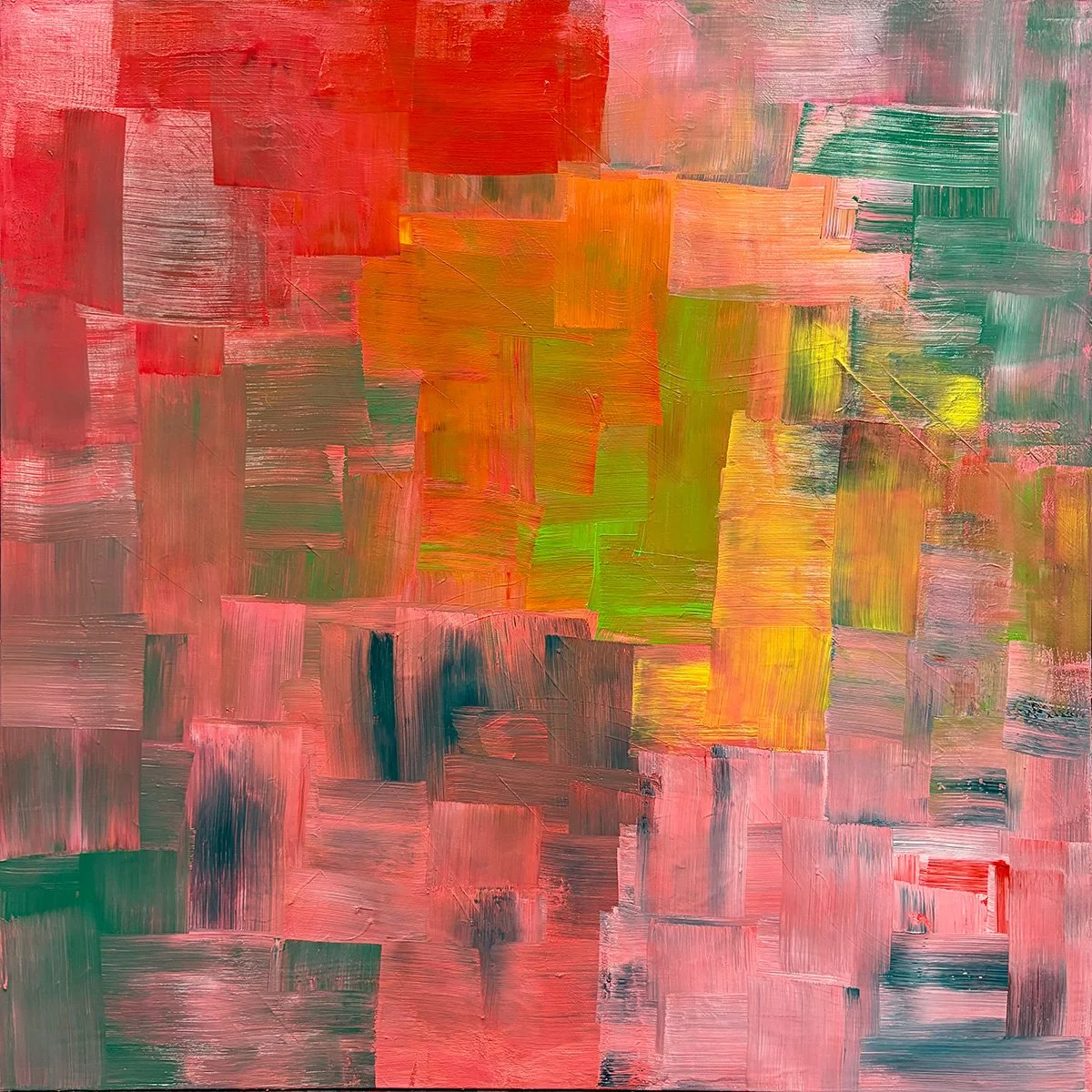
State I
The woven field
Interlocking gestural strokes. Warm and unresolved. A murmur looking for a reason.
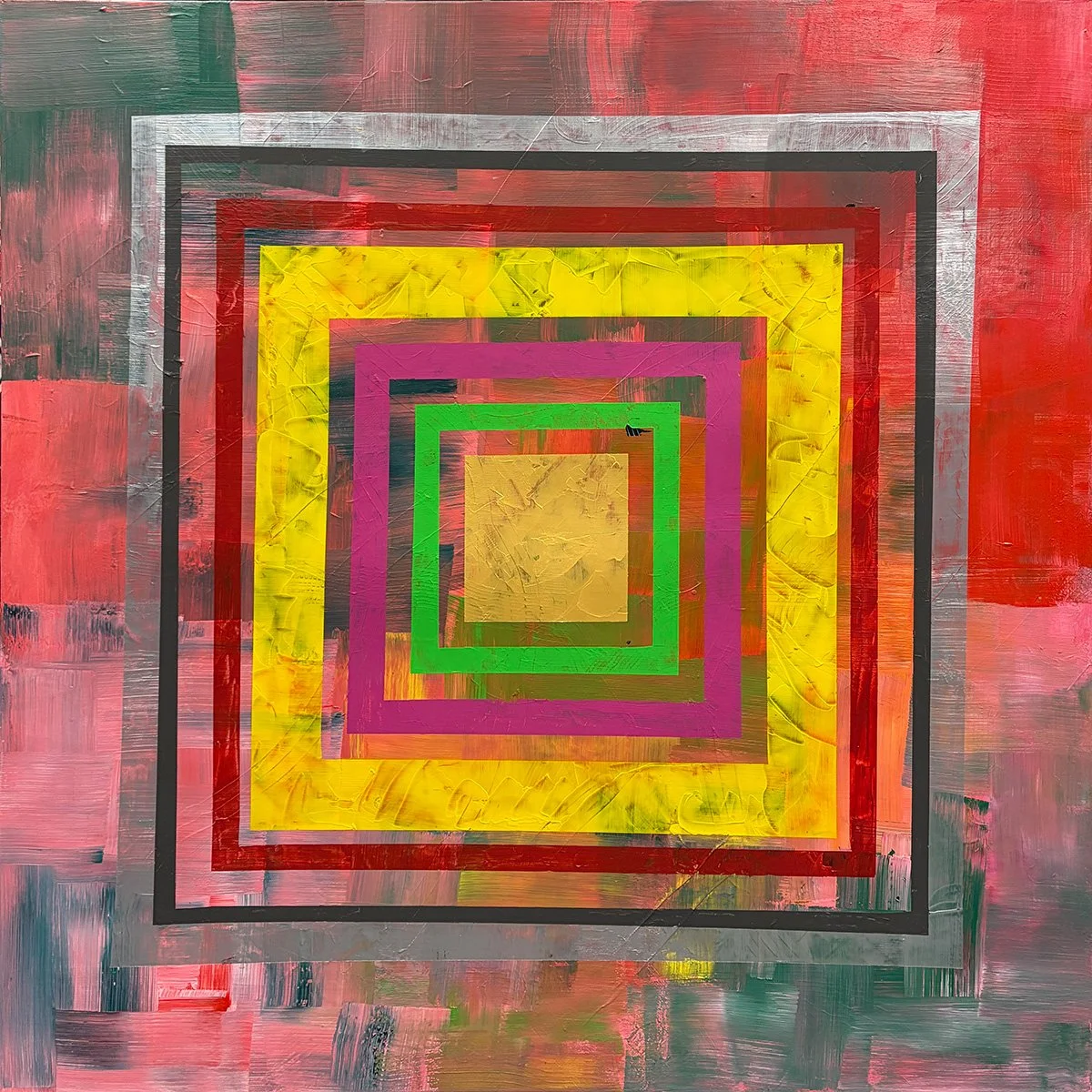
State II
Geometry arrives
Concentric squares over the field. Structure imposed. The underpainting refused to recede.
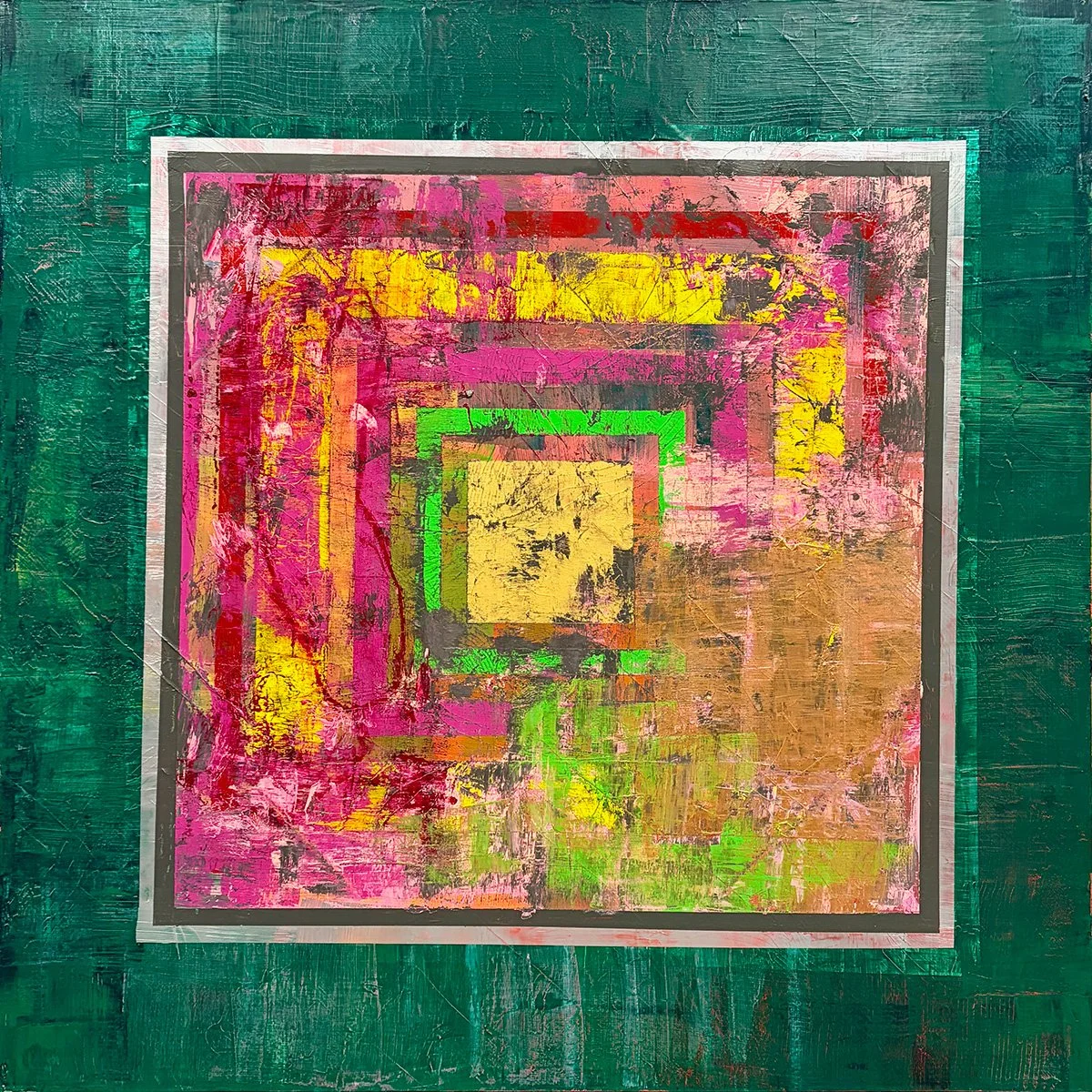
State III
Silence, finally
Deep teal surrounds everything. The interior combustion becomes legible. The painting lands.
I The field that wouldn't anchor
It began as a grid — not a geometric declaration, but something more intuitive. Interlocking strokes built a woven surface of reds, pinks, greens, and ochres. The structure was genuinely there. The intelligence was present. And yet the painting was soft in the way that discomforts me: every passage at the same volume, every mark making an equivalent claim on the eye.
"The greens in the upper right were the most alive corner — probably because the contrast there was sharpest. The rest of the canvas was one sustained murmur."
The palette had collapsed toward a uniform mid-tone. The darks weren't dark enough to anchor; the lights weren't light enough to lift. It was a painting of equal parts — and equal parts is another way of saying nothing is primary.
II Geometry over combustion
I painted over it. Concentric squares — a structural move, a bid for hierarchy, a way of creating silence through form. The geometry was meant to pull the eye inward, to create a center that the surrounding field would serve. But the underpainting was still winning.
The warm, uniform patchwork beneath bled through the borders, softened the edges, and pulled everything back into that same pink murmur. The concentric structure floated rather than cut. Geometry without contrast is just pattern — it decorates rather than decides.
"The center square — raw gold-ochre — was the most interesting moment. It had the quiet. But it was surrounded by a magenta-green-yellow sequence where every ring shouted at the same volume."
The problem wasn't the idea. The idea was right. The problem was the field beneath it still held too much power — warm neutralizing warm, no cold passage to cut through, no moment where the eye could stop and breathe before entering.
III The border that made everything possible
The final palette — depth, then fire
The answer was a single decision: a deep forest teal border, absolute and wide, surrounding everything. Not a frame in the decorative sense — a wall. A deliberate silence that gives the interior combustion somewhere to burn.
With the teal in place, the magenta, yellow, lime, and pink inside the concentric structure stopped competing with the field and started meaning something. The eye now has a journey: from stillness at the edge, through the geometry, into the layered chaos at the center — where history lives, where three states of the canvas are simultaneously present.
"This painting contains everything it ever was. The patchwork field is still there, underneath. The geometry arrived on top of it. The teal border came last and made both legible."
What I find most honest about this painting is that it carries its own archaeology. You can feel the layers — not as mistake and correction, but as accumulation. The canvas remembered everything I asked it to forget, and eventually I stopped asking.
Some paintings need to be rescued from themselves. Some need to be pushed harder. And occasionally, one simply needs a border dark enough to finally let the light inside be light.
This one found its voice in the third life. I am glad I did not abandon it in the second.