Childhood Influences – Growing Up Around Art, Ideas, and Abstraction
Growing up in New Delhi, I didn’t just learn about art — I lived among it. My father, K.B. Goel, and artists like M.F. Husain and Raghu Rai shaped my understanding of abstraction as a way of life, not just a style.
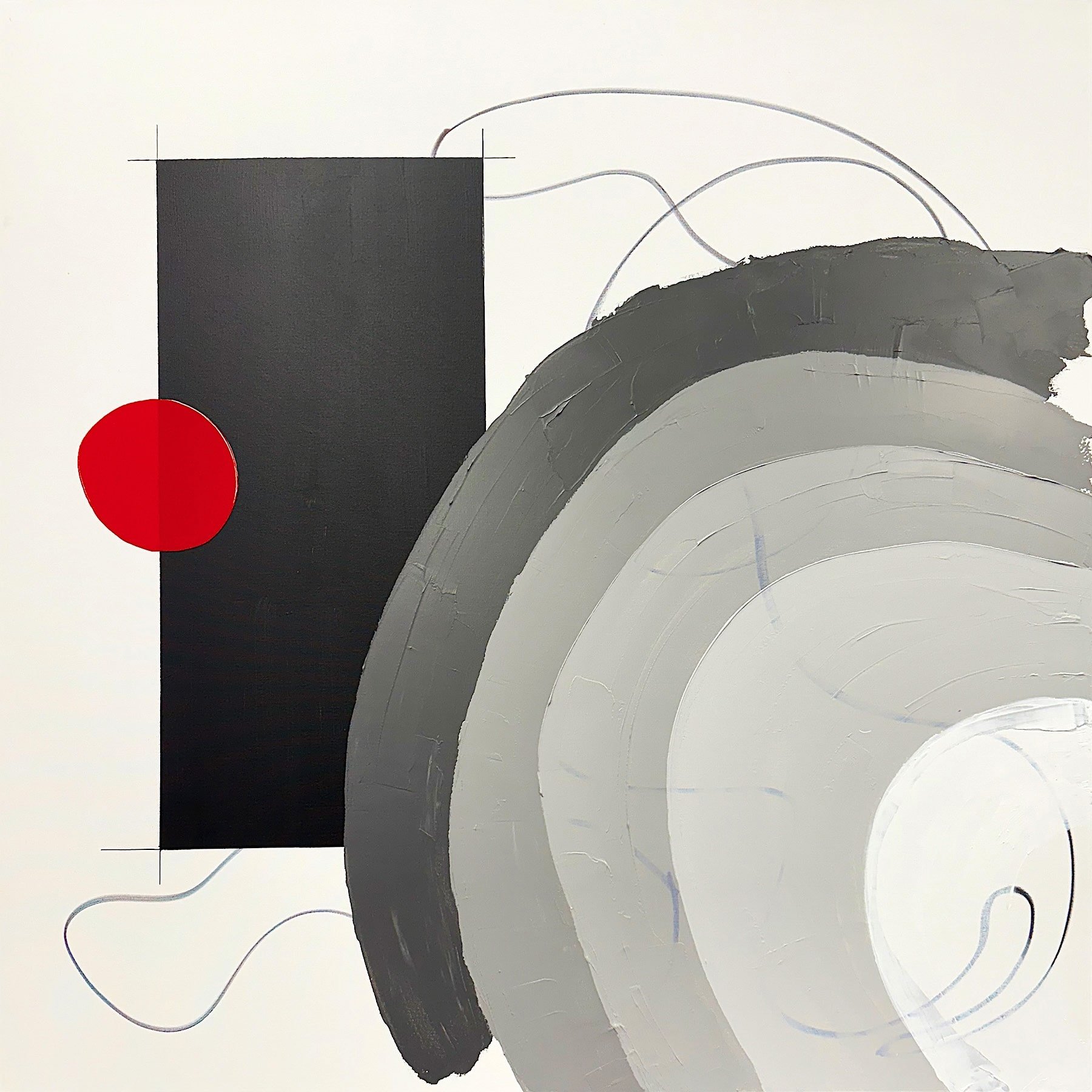
Grey Rainbow, 5ft x 5ft, Greyscale, 2025
When people ask me why I create abstract art, I often return to my childhood. I didn’t grow up thinking art was separate from life. In our home in New Delhi, abstraction wasn’t an academic term — it was woven into conversation, criticism, and curiosity.
My father, K.B. Goel, was one of India’s leading art critics. His essays shaped national discourse on modernism and abstraction. But to me, he was simply my father — a man who could see beyond surfaces, who taught me that meaning was rarely obvious, and who found beauty in complexity and contradiction. His advocacy of Abstract Expressionism wasn’t just about aesthetics; it was about freedom of thought, the courage to create without explanation, and the integrity to stand by what moved you.
Our living room was often filled with the quiet intensity of creative minds. Photographer Raghu Rai would visit, his words grounded yet poetic. Painters like M.F. Husain and F.N. Souza came through, each carrying their own universe of gestures, philosophies, and provocations. I absorbed their presence before I ever understood their fame. I was just a child watching adults talk about color as feeling, form as philosophy, and art as a way to disrupt complacency.
At the time, I didn’t know how deeply these experiences shaped me. I studied mathematics, built companies in technology and design, and spent decades solving problems in structured, linear ways. But beneath it all was the early imprint of abstraction — a comfort with ambiguity, an instinct to see patterns, and a belief that what is unspoken can still be deeply felt.
Today, when I paint, I don’t think about recreating what they taught me. I think about how they lived: curious, rigorous, and unapologetically themselves. My work is abstract, but it is also autobiographical — each gesture carries those early echoes of conversation, critique, and wonder.
Art was never just something to hang on a wall. It was a way to ask better questions about who we are and what we’re here to create.