I no longer believe I make paintings. I believe I become the conditions under which they arrive. This is not humility. It is the most precise thing I know about what happens in the studio.
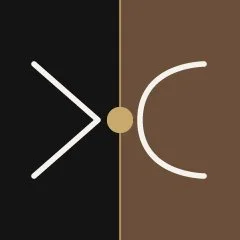
Expression of Self, Black & White Collection, 5×5 ft
I no longer believe I make paintings.
I believe I become the conditions under which they arrive.
This is not humility. It is the most precise thing I know about what happens in the studio — after five years of full-time practice, after more than three hundred and eighty works, after long hours in which I stopped instructing and started listening. Something shifted in how I understand my own role. I am not standing outside the work, applying myself to it. I am inside it. I am, in some essential way, it.
The question I keep returning to: what does it mean to be the medium — not the medium of paint or thread or canvas, but the medium in the way a room is a medium, the way atmosphere is, the way silence before music is?
The Usher at the Threshold
There is a word I've been turning over: usher.
An usher does not perform. An usher does not construct. An usher holds the threshold open so that something prepared elsewhere can arrive into the right space. The showing cannot happen without the usher — and yet the usher is never the show.
This is, I think, the most honest description of what I do.
My father spent his life writing about art — about Souza, Husain, Swaminathan. Growing up in New Delhi inside that world, I absorbed something I couldn't yet name: that the serious work of art was not decoration but inquiry. That a painting was not a made thing but a arrived thing. That the painter's discipline was not in controlling outcome but in preparing the conditions for truth.
It took me decades to understand what that meant in practice. A career in technology — building things that were genuinely new, companies at the edge of what was possible — trained me in a particular intelligence. Precise. Structural. Forward-facing. Useful, certainly. But not the intelligence that art requires.
Art requires a different orientation entirely. Not forward — but inward and outward simultaneously. Not construction — but allowance.
Thread as Surrender
The clearest expression of this in my work is the Organic Movement series — my signature technique, the one that has defined my practice from its earliest serious iterations.
I replaced the brush with thread.
That choice sounds technical. It is, at its root, philosophical.
A brush obeys. Thread wanders. When I lay thread across wet paint and pull, drag, suspend it — I am not dictating a line. I am proposing a direction and then watching what the material decides. The thread finds its own logic within the conditions I have created: the wetness of the paint, the weight of the fiber, the angle of my hand, the resistance of the surface. None of these are fully under my control. All of them are, precisely, my practice.
I am the field in which the thread moves. I am the environment of its becoming.
What emerges — those layered lines of gesture, that captured sense of motion frozen mid-breath — is not mine in the way a signature is mine. It is a collaboration between intention and material, between preparation and accident, between the artist as agent and the artist as ground.
Darkness as Precondition
The Out of Darkness collection taught me something about what the medium must be willing to hold.
These works begin in constraint. Deep fields — near-black, Rothko-heavy, absorbing light rather than reflecting it. And out of that density, color emerges: not triumphant, not announced, but found. The way a thought surfaces from somewhere below articulation. The way the first honest thing you say is always the thing you almost didn't say.
To paint these works, I had to become willing to sit inside the darkness without resolving it prematurely. That is an act of environmental trust. The medium — the field, the artist — must be capable of holding discomfort without collapsing it into false resolution.
This is not a technique. It is a temperament. It is a quality of being that the work demands of the person who makes it.
The darkness in these paintings is not subject matter. It is the condition of their becoming.
The Architecture of Inquiry
In the Abstract Inquiry series, the question becomes structural.
These works are not emotional in the way the Out of Darkness pieces are emotional. They are interrogative. They hold a proposition up to the light and rotate it — slowly, carefully — until its facets catch. Fragment of Thought. Submerged Structures. Bands of Tension. Rooms of the Unfinished.
The titles are not descriptions. They are questions wearing the clothes of answers.
What I discovered making these works is that inquiry — real inquiry, the kind that doesn't already know what it's looking for — requires the artist to become genuinely open. Not performing openness. Not the productive openness of the brainstormer. The vertiginous, uncomfortable openness of the person who has stopped knowing what they think and is listening, very carefully, to find out.
I am a mathematician by early training. I have spent years thinking in structures, in proofs, in the satisfaction of closed systems. Abstract Inquiry is where I bring that structural intelligence into contact with its own dissolution. The geometry is there — but it is always on the edge of becoming something the geometry alone cannot contain.
The artist as medium, here, is the space between rigor and release. Between knowing and not-knowing. Between the completed proof and the unresolved question that gives the proof its meaning.
The Grammar of Black and White
The Black & White collection — monochrome abstractions, stripped of color's emotional scaffolding — demands a different quality of presence.
Color is generous. It does much of the work for you. It carries association, temperature, memory. Remove it, and what remains is structure alone: the relationship between mark and ground, positive and negative, weight and lightness.
To work in black and white is to become a more austere kind of medium. There is nowhere to hide. The work is legible or it isn't. The tension is real or it's decoration.
What I found in this series is that the absence of color forces the artist — forces me — into a more honest relationship with form. I cannot soften an uncertain mark with a beautiful hue. The mark must be certain, or it must be absent. That discipline does something to the body making it. It quiets the improvisational mind and demands a kind of structural listening that is close to what a mathematician feels when a proof suddenly reveals its elegance.
The medium here is silence. The artist as environment is a space of very high signal and very low noise.
Precision as a Form of Wonder
Geometric Splendor is where my background in mathematics finds its most direct expression — and where the tension between control and surrender becomes most visible.
These works begin with precision. Edges that mean it. Color fields that hold their boundaries. The geometry of the cosmos rendered in paint and acrylic, in CNC-carved wood panels that make the surface itself a topography.
But the splendor is never merely formal. The geometry is always in the service of something beyond itself — a quality of wonder, an intimation that precision, taken far enough, becomes indistinguishable from the feeling of the infinite.
This is what I mean when I say the artist as medium must hold paradox without collapsing it. To be precise without being closed. To know the structure and remain astonished by it. The environment in which Geometric Splendor occurs is one where rigor and awe can coexist — where the proof and the gasp can happen in the same instant.
Atmosphere as Ontology
The Ephemeral Atmospheres series is the most direct expression of the theme I've been building toward.
These are works about the quality of presence itself — soft, suffused, at the edge of dissolution. They do not insist. They arrive. They fill the room the way light fills it: not by occupying space but by changing its character.
To make these paintings is to practice becoming atmospheric. To spread attention evenly, to resist the impulse to locate, to let the edges dissolve because the edges were always somewhat artificial. The artist here is not a point in space. The artist is the air.
There is a Japanese concept, ma — the pregnant pause, the meaningful interval, the space between that gives the sounds their shape. Ephemeral Atmospheres lives in ma. The paintings are not things. They are intervals. They are the space between the seeing and the having-seen.
I do not believe I made these works. I believe I became still enough that they could form.
What I Am Learning
Five years into this practice, across six collections and hundreds of works, I am learning that the most important thing I can do is improve the quality of the medium. Not learn new techniques — though technique matters.
Not acquire new references — though the lineage matters: Rothko's color theology, Richter's blur between order and disorder, Pollock's trust in the body's knowledge, Basquiat's refusal to separate intelligence from urgency.
But the most important thing is to become a better field. More permeable to what the work needs. Less insistent on what I had planned. More willing to be inside the becoming rather than supervising it from outside.
Abstraction is not a style. It is the point where intellect dissolves into awareness — where seeing becomes a form of being.
I wrote that sentence for my, The Shape of Seeing. I believe it more fully each time I enter the studio. And I believe its corollary more fully too:
The artist is not the one who sees. The artist is the condition under which seeing becomes possible.